Darkside Spirit Seekers PFG Explanation's
Welcome to Darkside Spirit Seekers PFG Explanation Cards
Here we have put some PFG Files that help to understand more in depth about the paranormal field e.g K2 Meters & Angels & Demons etc, we try to cover as many different areas that we can & keep you up to date on what each area means & the background.
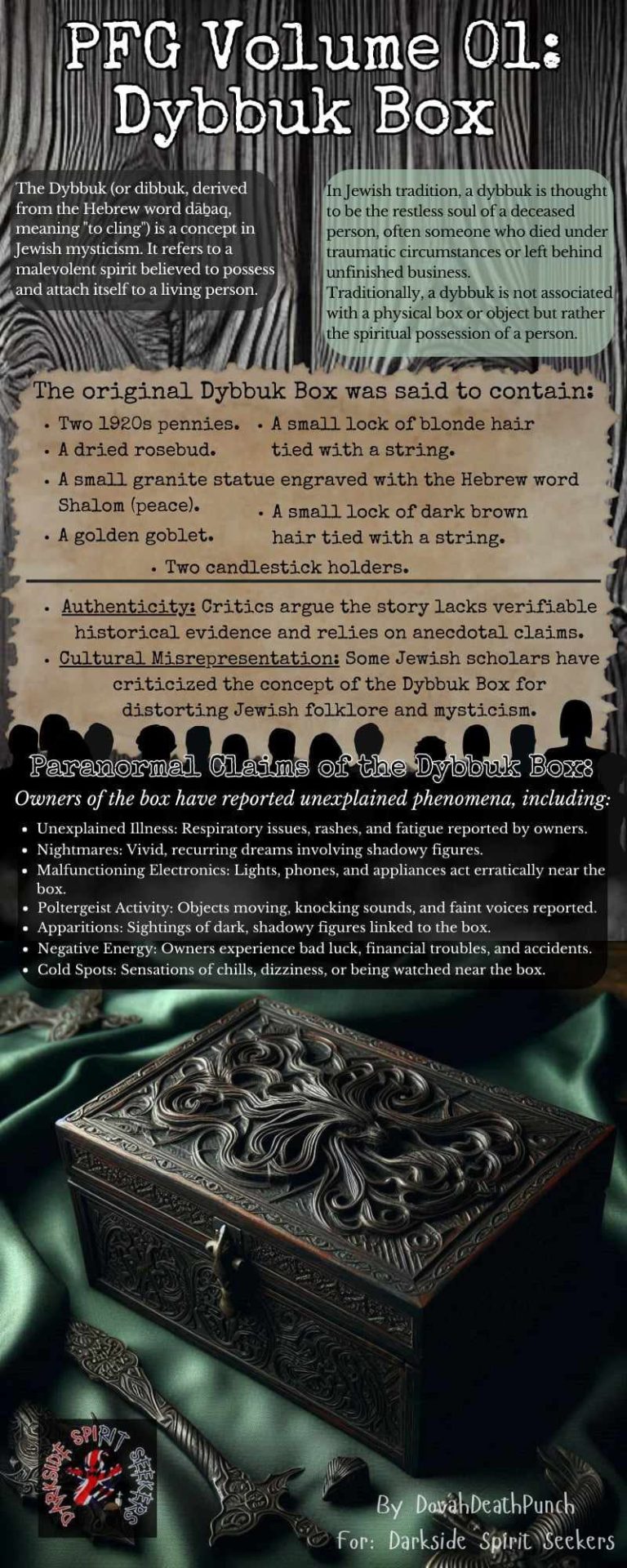
Darkside Spirit Seekers PFG Volume 1 The Dybbuk Box
Darkside Spirit Seekers PFG Volume 01 The Dybbuk Box
From Jewish folklore to an eBay purchase that left a man in a 'tidal wave of bad luck,' dybbuk boxes are wine cabinets claimed to be haunted by a dybbuk, a malicious demon said to hold the power to invade and possess a living person.
Authentic dybbuk boxes will usually come with some sort of backstory and certified documents, such as papers signed by a rabbi that state 'under all circumstances do not open.'
So, what exactly is a dybbuk box, where did the legend start, and how in the world did a man in California get his hands on one?
History of Dybbuk Boxes
A dybbuk, or dibbuk, in Jewish folklore is a disembodied human spirit that, because of former sins, wanders restlessly until it finds a haven in the body of a living person. Belief in such spirits was prevalent in the 16th and 17th centuries in eastern Europe.
The word dybbuk is an adaptation of the Hebrew root davek, which means to cling or to cleave. A dybbuk is considered to be a sticky, evil spirit -- a deceased, disembodied malcontent who clings to a living person in order to find respite from its troubles. The phenomenon of being overcome by an otherworldly spirit has a long history in Judaism. In the book of Samuel, David rids King Saul of “a spirit of melancholy from God” by playing his harp. The idea of the dybbuk gained traction in the 16th century, when kabbalah, flourishing in the northern Galilee city of Tzfat, promulgated ideas about the afterlife.
Often individuals suffering from nervous or mental disorders were taken to a miracle-working rabbi, who alone, it was believed, could expel the harmful dybbuk through a religious rite of exorcism.
Isaac Luria, a mystic, laid the grounds for Jewish belief in a dybbuk with his doctrine of the transmigration of souls, which he saw as a means whereby souls could continue their task of self-perfection. His disciples went one step further with the notion of possession by a dybbuk.
Dybbuks are basically malevolent spirits looking for a warm body to call home. So, what could go wrong when buying a strange box with a dybbuk inside on eBay?
eBay and the Dybbuk Box
Copyright by US Ghost Adventures
As the story goes, a dybbuk box appeared in 2003 when antique store owner Kevin Mannis bought a vintage wine box from a 103-year-old Holocaust survivor on eBay. After a strange string of unexplained hauntings, recurring nightmares, bruises, and smells of ammonia, the box found its way back onto eBay and landed in the hands of a man named Jason Haxton. He too felt the wrath of the box, and ended up burying it somewhere in Missouri, but not before pulling it out of the ground to appear on the television show Ghost Adventures.
Haxton stated that:
'The day it arrived, I put my hands on it, and it almost feels like the thing collapses into a liquid state, I felt like a knife was coming into my guy, I was paralyzed in pain. When I go to bed, I have terrible dreams of a hag that seems to come with the box.'
Haxton said he first heard about the box from a colleague whose roommate had listed it for sale after a string of terrifying events.
The box is said to have come from an Oregon estate sale of a Holocaust survivor. The person who bought the box at the estate sale was told that the box was 'always shut, and set in a place that was out of reach. It was never, ever to be opened.'
Haxton had paid $280 for the box, and when opened, contained a goblet, two locks of hair tied with string, pennies from the 1920s, a dried rosebud, a cast iron candlestick holder, and a granite statue engraved with Hebrew letters. Haxton said that he didn't believe the stories associated with the box, and didn't have any worries when opening it.
After he acquired the box, he became very ill. He called it a 'tidal wave of bad luck.'
Haxton stated that all of his issues vanished when he followed a rabbi's advice to place the cabinet in a gold-lined wooden container to negate whatever entity was inside. He now keeps the cabinet inside a military-grade case, which he buried.
Thousands of folks have offered to buy the box for any price, but Haxton states it's unethical for him to sell it.
The Box's Resurfacing
Haxton states that he isn't worried by the box's resurfacing -- he believes that the dybbuk's unfinished business is finished. In fact, Haxton now believed that the dybbuk box's energy has reversed, so much so that he calls it his personal 'fountain of youth,' and states that his vitals are better now than when he was 40 -- he attributes his enhanced feeling to the haunted heirloom.
Today, the market is full of dybbuk boxes. Boxes are on online auction marketplaces such as eBay for as low as $20, some as high as $1,000. Haxton states that most of these boxes are fake, just made to be a creepy accouterment to show off to your friends. He says that there are only a few 'real' boxes in the world -- but who in the world would take the risk?
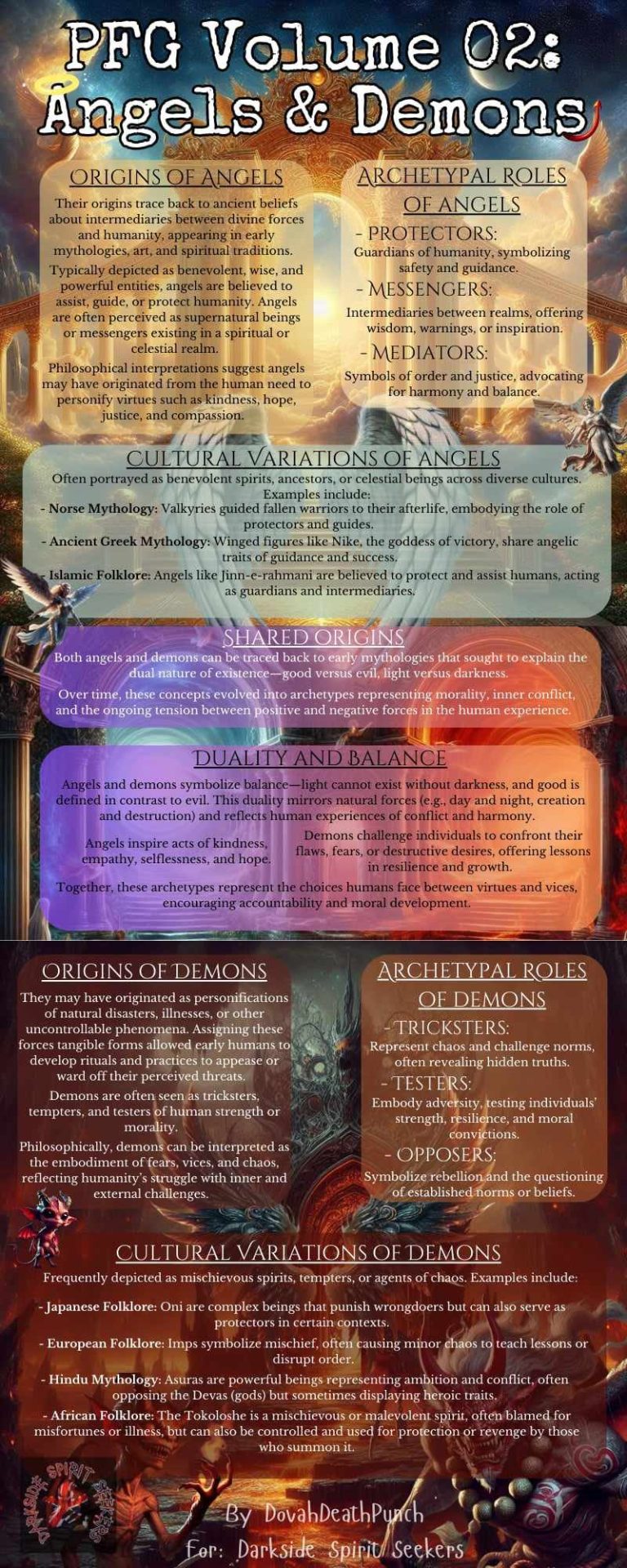
Darkside Spirit Seekers PFG Volume 2 Angels & Demons
Darkside Spirit Seekers PFG Volume 02 Angels & Demons
Angels are benevolent spiritual beings created by God, while demons are fallen angels who rebelled against God and serve evil.
Nature and Origin
Roles and Functions
Characteristics
Conclusion
The fundamental difference between angels and demons lies in their allegiance and purpose. Angels serve God and promote good, while demons rebel against God and embody evil. Understanding these differences helps in recognizing the spiritual dynamics at play in various religious and moral contexts.
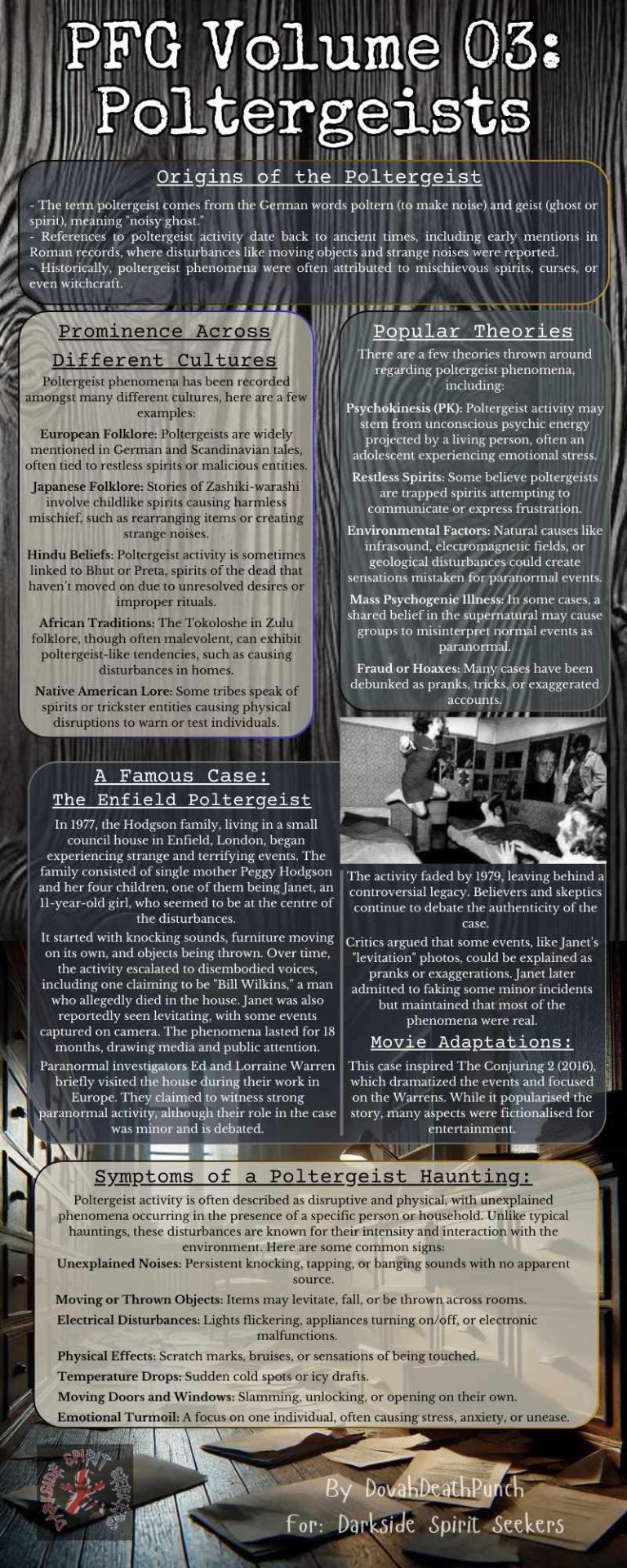
Darkside Spirit Seekers PFG Volume 3 Poltergeists
Darkside Spirit Seekers PFG Volume 03 Poltergeists
In German folklore and ghostlore, a poltergeist (/ˈpoʊltərˌɡaɪst/ or /ˈpɒltərˌɡaɪst/; German: [ˈpɔltɐɡaɪ̯st] ⓘ; 'rumbling ghost' or 'noisy spirit') is a type of ghost or spirit that is responsible for physical disturbances, such as loud noises and objects being moved or destroyed. Most claims or fictional descriptions of poltergeists show them as being capable of pinching, biting, hitting, and tripping people. They are also depicted as capable of the movement or levitation of objects such as furniture and cutlery, or noises such as knocking on doors. Foul smells are also associated with poltergeist occurrences, as well as spontaneous fires and different electrical issues such as flickering lights.
These manifestations have been recorded in many cultures and countries, including Brazil, Australia, the United States, Japan and most European nations. The first recorded cases date back to the 1st century.
Skeptics explain poltergeists as juvenile tricksters fooling credulous adults.
The word poltergeist comes from the German language words poltern 'to make sound, to rumble' and Geist 'ghost, spirit' and the term itself translates as 'noisy ghost', 'rumble-ghost' or a 'loud spirit'.
Hoax
Many claims have been made that poltergeist activity explains strange events (including those by modern self-styled ghost hunters), however, their evidence has so far not stood up to scrutiny. Many claimed poltergeist events have been proven upon investigation to be hoaxes.
Psychical researcher Frank Podmore proposed the 'naughty little girl' theory for poltergeist cases (many of which have seemed to centre on an adolescent, usually a girl). He found that the centre of the disturbance was often a child who was throwing objects around to fool or scare people for attention. Skeptical investigator Joe Nickell says that claimed poltergeist incidents typically originate from "an individual who is motivated to cause mischief" According to Nickell:
In the typical poltergeist outbreak, small objects are hurled through the air by unseen forces, furniture is overturned, or other disturbances occur—usually just what could be accomplished by a juvenile trickster determined to plague credulous adults.
Nickell writes that reports are often exaggerated by credulous witnesses.
Time and time again in other "poltergeist" outbreaks, witnesses have reported an object leaping from its resting place supposedly on its own, when it is likely that the perpetrator had secretly obtained the object sometime earlier and waited for an opportunity to fling it, even from outside the room—thus supposedly proving he or she was innocent.
According to research in anomalistic psychology, claims of poltergeist activity can be explained by psychological factors such as illusion, memory lapses, and wishful thinking. A study (by Lange and Houran, 1998) wrote that poltergeist experiences are delusions "resulting from the affective and cognitive dynamics of percipients' interpretation of ambiguous stimuli". Psychologist Donovan Rawcliffe has written that almost all poltergeist cases that have been investigated turned out to be based on trickery, whilst the rest are attributable to psychological factors such as hallucinations.
Psychoanalyst Carl Gustav Jung was interested in the concept of poltergeists and the occult in general. Jung believed that a female cousin's trance states were responsible for a dining table splitting in two and his later discovery of a broken bread knife.
Jung also believed that when a bookcase gave an explosive cracking sound during a meeting with Sigmund Freud in 1909, he correctly predicted there would be a second sound, speculating that such phenomena were caused by the 'exteriorization' of his subconscious mind. Freud disagreed, and concluded there was some natural cause. Freud's biographers maintain the sounds were likely caused by the wood of the bookcase contracting as it dried out.
Unverified natural phenomena
Attempts have also been made to scientifically explain poltergeist disturbances that have not been traced to fraud or psychological factors. Skeptic and magician Milbourne Christopher found that some cases of poltergeist activity can be attributed to unusual air currents, such as a 1957 case on Cape Cod where downdrafts from an uncovered chimney became strong enough to blow a mirror off a wall, overturn chairs and knock things off shelves.
In the 1950s, Guy William Lambert proposed that reported poltergeist phenomena could be explained by the movement of underground water causing stress on houses. He suggested that water turbulence could cause strange sounds or structural movement of the property, possibly causing the house to vibrate and move objects. Later researchers, such as Alan Gauld and Tony Cornell, tested Lambert's hypothesis by placing specific objects in different rooms and subjecting the house to strong mechanical vibrations. They discovered that although the structure of the building had been damaged, only a few of the objects moved a very short distance. The skeptic Trevor H. Hall criticized the hypothesis claiming if it was true "the building would almost certainly fall into ruins." According to Richard Wiseman the hypothesis has not held up to scrutiny.
Michael Persinger has theorized that seismic activity could cause poltergeist phenomena. However, Persinger's claims regarding the effects of environmental geomagnetic activity on paranormal experiences have not been independently replicated and, like his findings regarding the God helmet, may simply be explained by the suggestibility of participants.
David Turner, a retired physical chemist, suggested that ball lightning might cause the "spooky movement of objects blamed on poltergeists."
- Sampford Peverell (1810–1811) - poltergeistal noises were determined made by smugglers from behind a false wall
Paranormal
Parapsychologists Nandor Fodor and William G. Roll suggested that poltergeist activity can be explained by psychokinesis.
Historically, actual malicious spirits were blamed for apparent poltergeist-type activity, such as objects moving seemingly of their own accord. According to Allan Kardec, the founder of Spiritism, poltergeists are manifestations of disembodied spirits of low level, belonging to the sixth class of the third order. Under this explanation, they are believed to be closely associated with the elements (fire, air, water, earth). In Finland, somewhat famous are the case of the "Mäkkylä Ghost" in 1946, which received attention in the press at the time, and the "Devils of Martin" in Ylöjärvi in the late 19th century, for which affidavits were obtained in court. Samuli Paulaharju has also recorded a memoir of a typical poltergeist — the case of "Salkko-Niila" — from the south of Lake Inari in his book Memoirs of Lapland (Lapin muisteluksia). The story has also been published in the collection of Mythical Stories (Myytillisiä tarinoita) edited by Lauri Simonsuuri.

Darkside Spirit Seekers PFG Volume 4 K-II Meter
Darkside Spirit Seekers PFG Volume 4 K-II Meters
The K2 EMF Meter is an amazing EMF meter and an outstanding tool for paranormal research since it samples EMF levels at very fast speeds. This makes it very reactive to ghosts that tries to manipulate the EMF field to alert us of its presence. We’ll see the results by the K2’s led lights lighting up all of a sudden. The colorful lights make it very clear to viewers that the K2 meter is registering changes in EMF levels. These sudden erratic increases of EMF level were not present earlier. Hence unusual and unexplained. That is paranormal. This activity is easy to see from far away and in the dark thanks to the colourful led lights of the K2 meter. One has often seen this on TV shows of the Paranormal. It is easy to see from a distance. The most important and remarkable aspect of the K2 meter is that it is so efficient at capturing ghostly activity. Its superiority over other meters and it’s outstanding ability have been proven time and time again. One often sees the K2 meters lights going off in unison with other evidence occurring on other type of meters or/and audio/video recorders and people hearing and seeing suspected evidence of the paranormal. K2 EMF meters are also great for doing Q & A sessions. The lights of the meter responds with a certain number of times it lights up for Yes and another number of times for No in accordance as one has instructed the participating spirit or spirits. Or one can have several K-II meters and label on as the Yes meter and another as the No meter and a third and fourth for some other meaning and so on.
Darkside Spirit Seekers PFG Cards
Darkside Spirit Seekers PFG Volume Cards Continued
Continuation of the PFG Cards Explaining Different areas of Paranormal ETC
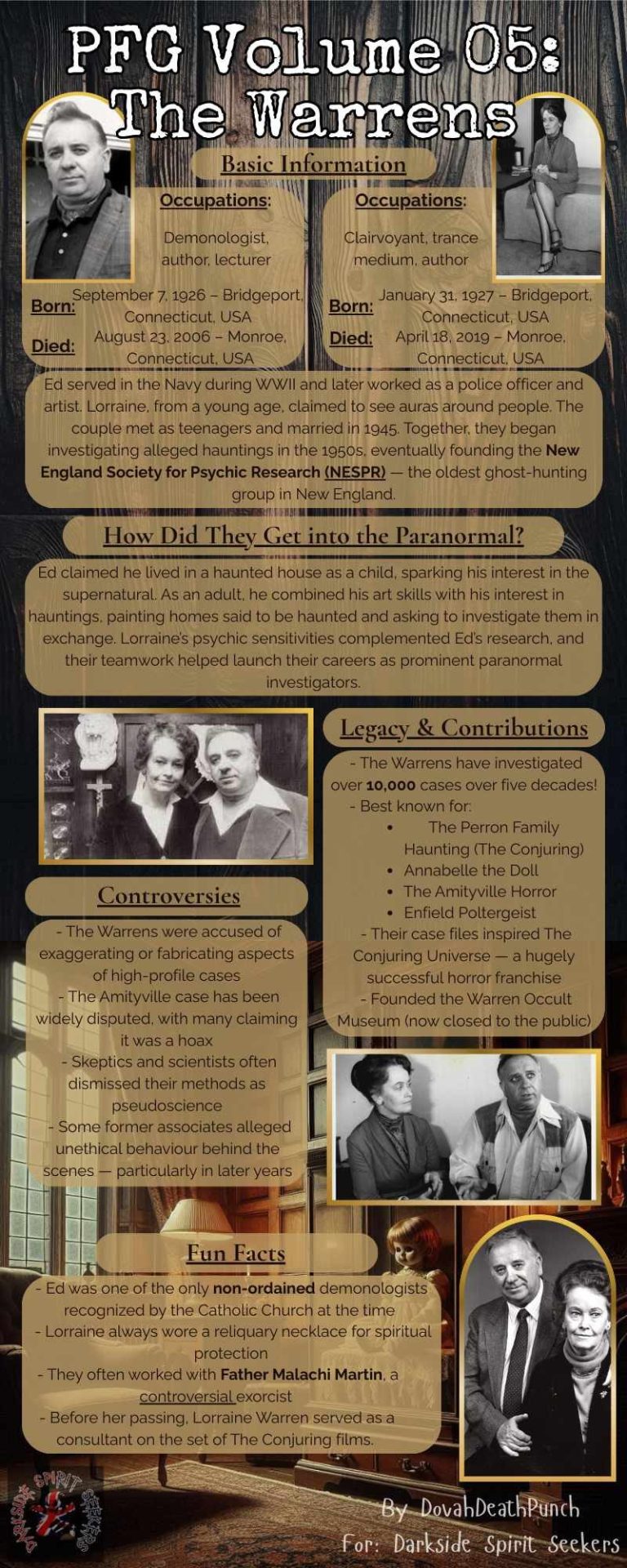
Darkside Spirit Seekers PFG Volume 05 The Warrens
Darkside Spirit Seekers PFG Volume 5 The Warrens
Paranormal Partners in Crime: Who Were Ed and Lorraine Warren?
Before Ghostbusters, Ghost Hunters, or even the 1977 classic In Search Of, you couldn’t tiptoe through a creaky haunted house in the Northeast US without bumping into the Warrens. They were the original ghost-hunting power couple; the legendary duo of the paranormal world.
Before Hollywood transformed their tales of the supernatural into box office hits, Ed and Lorraine Warren had already established a reputation for themselves as paranormal investigators by exploring cases of hauntings and the unexplained.
The beginning
Edward Warren Miney was born on September 7, 1926, in Bridgeport, Connecticut, and had a childhood that was anything but ordinary. It was at the age of five that Ed Warren had his first encounter with the supernatural.
Just three blocks away from Ed’s home lived Lorraine Moran, born on January 31, 1927. Her early life was marked by a Catholic upbringing and a journey into the realm of clairvoyance. It was at the age of 12 when Lorraine would discover her peculiar gift, one deemed sinful by her family.
Ed and Lorraine meet
In June 1943, Ed would cross paths with Lorraine. It was at that moment that Lorraine knew they were destined to spend the rest of their lives together. And did they, with a bond that would last over half a century!
On May 22, 1945, Ed and Lorraine exchanged vows, and on January 11, 1946, they welcomed their daughter Judy Warren into the world.
A growing paranormal portfolio
Suffice it to say, Ed, a self-proclaimed demonologist, and Lorraine Warren, a trance medium and clairvoyant, were far from an ordinary couple. In fact, the Warrens claimed to have taken on close to 10,000 paranormal investigations.
In 1952, they founded the New England Society for Psychic Research (NESPR), one of New England’s oldest ghost-hunting groups.
Over the years, they meticulously documented their spine-tingling experiences, collecting interviews, eerie audio and hair-raising video recordings. And, of course, the many occult artefacts tied to paranormal activity.
The Most Famous Cases Investigated by Ed and Lorraine Warren
The Annabelle Doll (1970)
Ah, the infamous Annabelle doll. You’ve certainly heard of her! She’s a Raggedy Ann doll claimed to be haunted by a spirit named Annabelle Higgins.
Initially given to a young nurse named Donna by her mother, the doll became the focal point of a terrifying series of events. Donna and her roommate noticed the doll frequently changing positions and found eerie notes reading “help me” in a child’s handwriting.
The doll would eventually fall into the hands of the Warrens, who believed the doll harboured a malevolent, demonic spirit.
Today, the doll remains locked in a glass case in the Warren’s Occult Museum with the sign “WARNING. POSITIVELY DO NOT OPEN.”
The Amityville Horror (1975)
The Amityville Horror surrounding the Lutz family was perhaps the Warren’s most famous case.
They had moved into a seemingly idyllic suburban home, unaware of the gruesome events that had transpired there just a year before when Ronald DeFeo Jr. murdered six family members.
During the first 28 days of their stay, George and Kathy Lutz claimed a host of paranormal activity plagued them, from swarms of flies and disturbing entities to even witnessing family members levitating.
The Warrens were called in to cleanse the house, with a local TV crew accompanying them.
The Perron Family (1974)
If you’ve watched The Conjuring movie, then you’ll likely recognise this eerie case. It began when Roger and Carolyn Perron moved their five daughters into a sprawling 200-acre farmhouse, oblivious to its dark history.
Tragic deaths occurred within its walls, and it didn’t take long for the Perron family to sense a malevolent presence lingering in the home.
In 1974, the Perrons reached out to Ed and Lorraine for help, but their intervention seemed to intensify the haunting, eventually leading Roger Perron to ask them to leave.
The Snedeker House (1986)
Imagine moving into a house, only to uncover one of the most chilling secrets. This is exactly what happened to Carmen and Al Snedeker when they rented a home in Southington, Connecticut.
Upon exploring their new home, they stumbled upon mortuary tools in the basement. This was no cosy abode, but a former funeral parlour – and it appeared that many of the former “clients” never truly departed.
Unsettling events began to unfold. The air carried the unmistakable stench of decaying flesh, and the tap water occasionally ran an eerie shade of blood-red. They even claimed that their eldest son began experiencing haunting visions.
The Smurl Haunting (1974)
The Smurl haunting is as nightmarish as it gets, and it seems haunted houses have a penchant for appearing “seemingly ordinary”.
In 1974, Jack and Janet Smurl moved into a – you guessed it – a seemingly ordinary house in West Pittston, Pennsylvania. Little did they know that their new home held a malevolent entity unlike any other.
The haunting escalated when the Smurls claimed that the demon had thrown their German Shepherd into a wall, bitten Jack’s ear, and even pushed one of their daughters down a flight of stairs.
But it was only 12 years later that the Smurl family, desperate for help, contacted the Warrens who confirmed the haunting. Ed Warren himself reported witnessing a sinister “dark mass” within the house.
Arne Cheyenne Johnson – ‘The Devil Made Me Do It’ (1981)
The Brookfield paranormal trial of 1981, later inspiring The Conjuring: The Devil Made Me Do It. centred around Arne Cheyenne Johnson, who was accused of brutally murdering his landlord, Alan Bono.
What made this trial exceptional was Johnson’s defence – he claimed he was under demonic possession at the time. This marked the first instance of such a defence in American legal history.
Ed and Lorraine spent considerable time with Johnson’s family, finding compelling evidence of paranormal influence. But, despite their efforts, the judge ultimately dismissed the demonic possession theory, sentencing Johnson to 10–20 years, of which he served five.
Where Are The Warrens Now?
Both Ed and Lorraine Warren have since passed away, Ed Warren in 2006 and Lorraine Warren in 2019. But their legacy lives on, not only through the history of their paranormal investigations but through their daughter Judy and son-in-law, Tony Spera.
With over 30 years of experience working alongside Lorraine and Ed, Spera now serves as the Director of the New England Society for Psychic Research (NESPR) and the head curator of the Warren Occult Museum. He continues to actively investigate demonic activity, preserving the legacy and artefacts of the Warren family.
FAQs
What are the most famous movies based on the Warrens?
The most famous movies based on the Warren’s paranormal cases include:
- The Amityville Horror (1979)
- The Haunted (1991)
- The Haunting in Connecticut (2009)
- The Conjuring movies (2013-2021)
- Annabelle (2014)
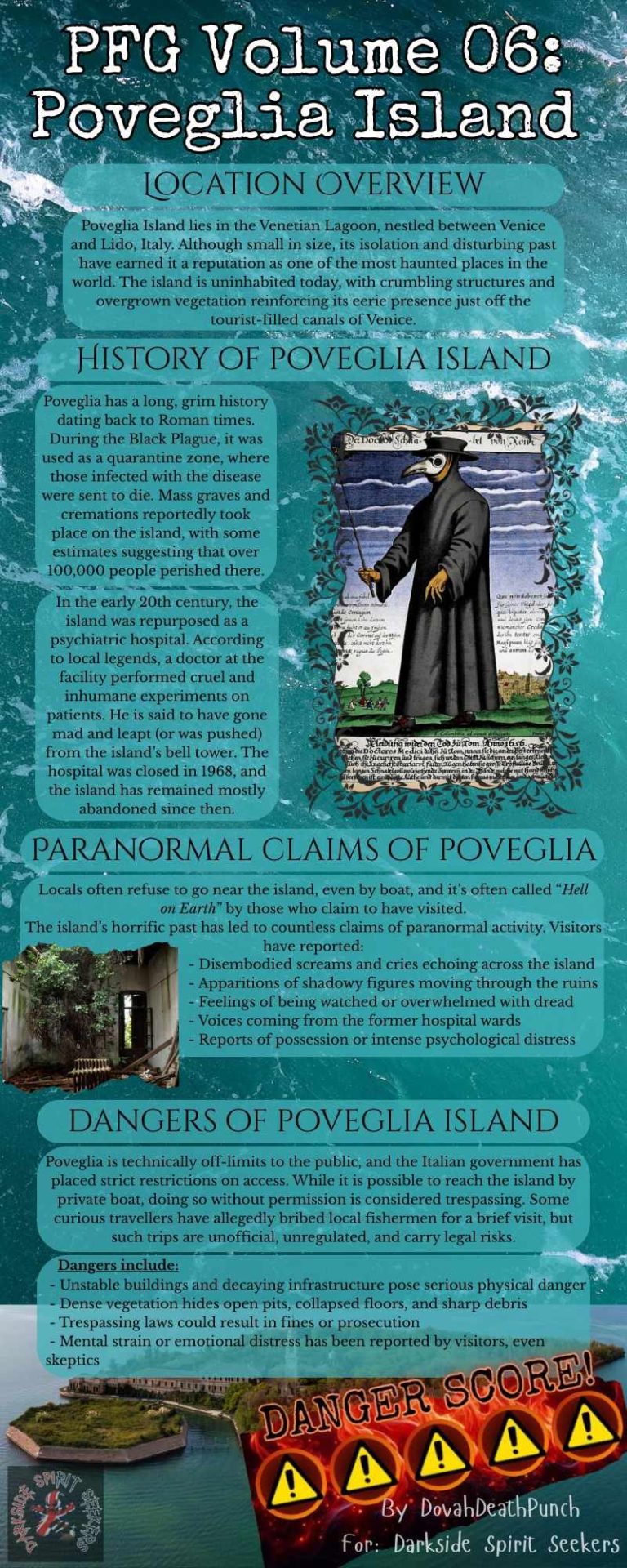
Darkside Spirit Seekers PFG Volume 06 Poveglia Island
Darkside Spirit Seekers PFG Volume 6 Poveglia Island
Known as one of the most illegal places one could (but really shouldn't) visit, Poveglia Island sits just off the coast of northern Italy near Venice. When most people begin planning a trip to that part of the world, images of romantic walkways and Renaissance art come to mind - haunted islands, on the other hand, generally don't rank very high on anyone's must-see list.
But some visitors are still curious about the small, infamous Italian island that once hosted thousands of refugee black plague victims, serving as a quarantine island for those who were even suspected of harbouring the bacteria. The island remains one of the most haunted places in Italy; and despite the fact that it is illegal to visit Poveglia, thrill-seekers continue to consider it a cool, albeit creepy destination; however, everyone who has taken the chance of stepping foot on the island has left with absolutely no desire to ever return. Read on to learn more about this haunted island in Italy.
The Italian island of Poveglia has a history chock-full of tragic events going back thousands of years. During the Roman Empire, the island was used to house victims of the plague in order to protect the rest of the country, forcing inflicted people to live and die in isolation. Then, during the medieval era, when the plague returned and killed off nearly two-thirds of Europe's population, Poveglia was again called upon to take in the sick and dying.
Dead bodies quickly began to overcrowd the island and thousands were dumped into large, common graves. In many cases, the bodies were burned. Some overly cautious Italian communities even got into the habit of shipping away anyone who showed the slightest signs of illness. Many of those people had not actually been infected with the plague at all, and were literally dragged to Poveglia and dumped atop piles of rotting corpses.
The terrifying, negative energy that has been left in the wake of these deaths remains, even in the island's very soil.
When a mental hospital was opened on Poveglia Island in 1922, few people were very surprised. However, the arrival of droves of mentally disturbed patients to the island only served to enrich the legend of it being a place to avoid. The isolation and privacy offered by the island also allowed for disreputable scientists and doctors to do as they pleased to their patients.
Reports of wide spread abuse and heinous experiments began to float back to the mainland, bringing with them the screams of the tortured souls trapped there.
Poveglia legend tells of a particularly demented doctor who worked at the island's mental hospital in the early 20th century. His notorious experiments on patients are still shocking when told today. For instance, he believed that lobotomies were a great way to treat and cure mental illness, so he performed lobotomies on numerous patients, usually against their will. The procedures were heinously wicked, and painful, too. He used hammers, chisels, and drills with no anesthesia or concern for sanitation.
He supposedly saved his darkest experiments for special patients, whom he took to the hospital's bell tower. Whatever he did in there, the screams from those being tortured could be heard across the island.
Karma eventually caught up with the wicked doctor. According to the story, the doctor began to suffer his own mental torture and was pursued by the island's multitude of ghosts. Eventually, he lost his mind and climbed to the top of the bell tower and flung himself to his death below. There are varying accounts of his death, though. Some say he may have actually been pushed, either by an angry island spirit or by some of his furious patients.
Supposedly a nurse witnessed his fall, claiming that he initially survived, but that a ghostly mist overcame his body and choked him to death. Somehow, the mental hospital remained open until 1968.
Many believe that hundreds of thousands of tormented souls still remain trapped on Poveglia Island. From the massive influx of plague victims who were forced onto the island to those who were tortured at the mental hospital that was once stationed there, a sense of sorrow and suffering continues to permeate from the island to this day.
In fact, it has even been said that you can still hear their screams.
Visitors to Poveglia have been forbidden for decades. Of course, that doesn't stop the occasional thrill seeker from taking a boat over to the island. Some look at it as a dare; others are genuinely interested in experiencing a bit of the paranormal. However, all who venture there return shaken. One thing visitors report experiencing is the sensation of being watched. Others report being scratched and pushed by invisible forces.
Some entities have even been said to push visitors into walls or chase them down corridors.
With a history like that of Poveglia Island's, it stands to reason that the spirits of the tortured patients at the mental hospital would join up with the innumerable spirits of plague victims. Visitors to the hospital during its final years of operation, as well as illegal visitors since then, have reported harrowing paranormal experiences inside the buildings and on the grounds. Visitors report seeing shadows on the walls moving along with them as they explore the decaying facility.
And the handful of psychics who have been brought to the island claim that there is an energy that can only be described as malignant - with the presence of the angry spirits lingering there so deeply frightening psychics and paranormal experts that most of them refuse to ever return.
With more than 100,000 plague victims and mental patients buried on the small island of Poveglia, it is no surprise that human bones continue to wash up on its shores. This fact alone is enough to creep out any potential visitors or buyers - even fishermen steer clear of Poveglia's shallows for fear of picking up human bones in their nets.
Amid the numerous reports from illegal visitors is the story of a curiosity thrill-seeker who went to Poveglia with a group of friends. Upon entering the abandoned mental hospital, the illegal tourist reported a heavy sense of dread descend around them, followed by a deep voice that warned:
"Leave immediately, and do not return." The visitors immediately complied.
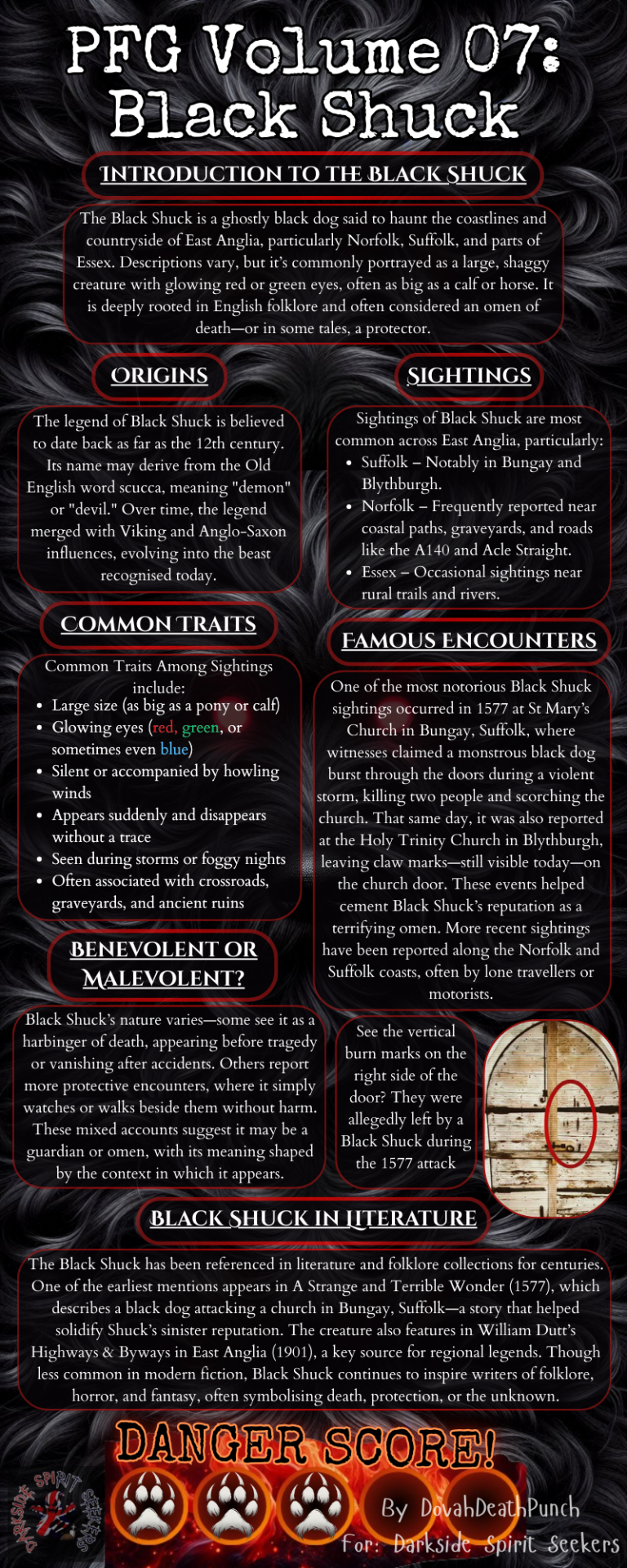
Darkside Spirit Seekers PFG Volume 07 Black Shuck
Darkside Spirit Seekers PFG Volume 7 Black Shuck
Black Shuck is a legendary ghostly black dog from English folklore, particularly associated with East Anglia, known for its terrifying presence and ominous appearances.
Origins and Characteristics
Notable Sightings and Stories
Cultural Significance
Conclusion
The Black Shuck legend remains a captivating part of English folklore, embodying themes of fear, death, and the supernatural. Its stories continue to intrigue and terrify, ensuring that Black Shuck will remain a significant figure in the cultural landscape of East Anglia and beyond.

Darkside Spirit Seekers PFG Volume 08 The Wild Hunt
Darkside Spirit Seekers PFG Volume 8 The Wild Hunt
The Wild Hunt is a widespread folklore motif in European mythology, often depicted as a ghostly procession led by a mythological figure, typically associated with death and catastrophe.
Origins and Key Figures
Cultural Significance
Variations Across Regions
Symbolism
In summary, the Wild Hunt is a rich and complex mythological motif that varies across cultures but consistently embodies themes of death, the supernatural, and the consequences of human actions. Its enduring presence in folklore highlights the shared fears and beliefs of different societies throughout history.
Darkside Spirit Seekers PFG Cards
Darkside Spirit Seekers PFG Volume Cards Continued
Continuation of the PFG Cards Explaining Different areas of Paranormal ETC
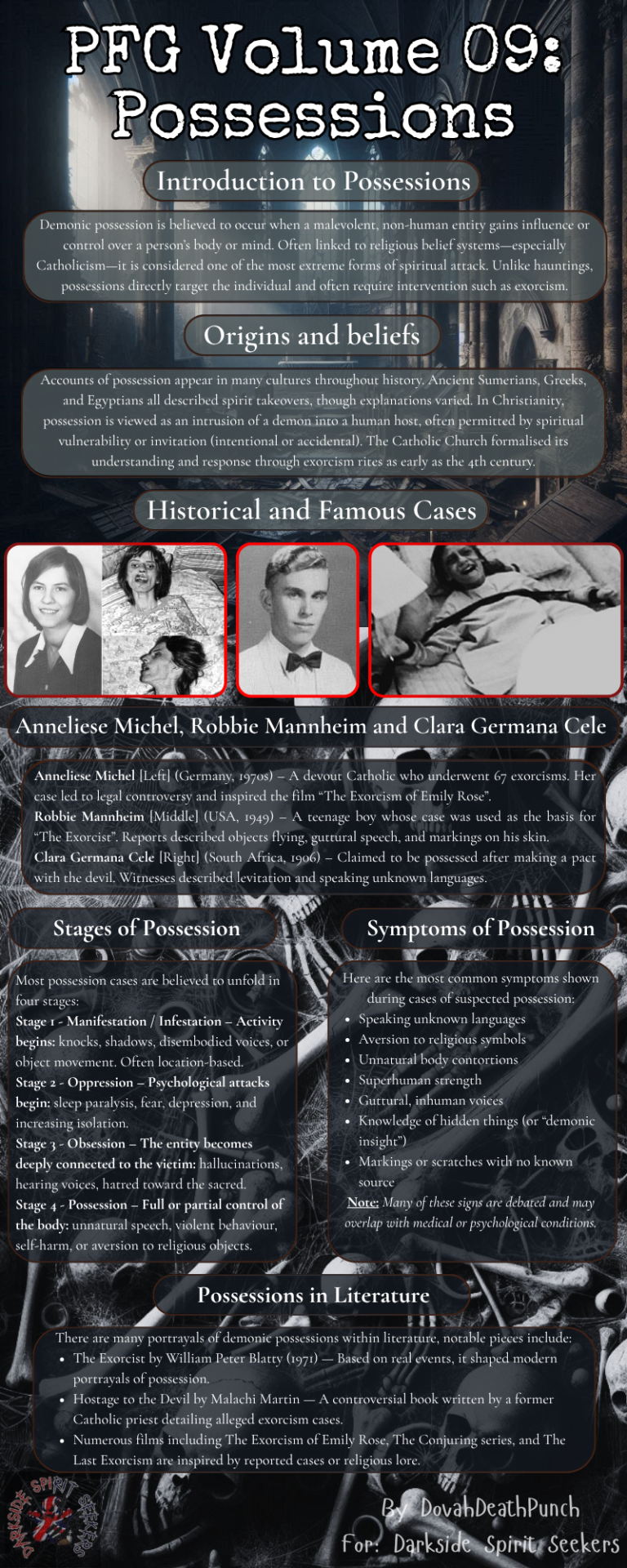
Spiritual Possessions
Spiritual Possessions
Spiritual possessions have intrigued and frightened humanity for centuries, with stories of possession appearing across different cultures, religions, and even media. Many associate the idea of possession with sinister forces and horror movies, but spiritual possession has deeper roots and more complex meanings in various traditions. In this article, we will explore what spiritual possessions are, real-life cases, and how different cultures and spiritual systems interpret and handle possession experiences.
What Are Spiritual Possessions?
At its core, a spiritual possession occurs when an external spiritual entity takes control of a person’s body and mind. This entity could be anything from a demon, ghost, deity, or other supernatural being, depending on the belief system. The concept of possession exists in many spiritual traditions, including Christianity, Islam, Hinduism, Vodou, and indigenous beliefs around the world.
In some cases, spiritual possession is seen as negative and harmful, requiring exorcism or other rituals to cast out the invading spirit. In other traditions, possession may be viewed as a form of divine intervention, with the person being blessed to channel a spirit or deity.
The concept of spiritual possession raises questions about the nature of the soul, free will, and the existence of a spirit world, which is why it continues to fascinate both spiritual seekers and skeptics alike.
Signs of Spiritual Possession
Spiritual possessions manifest in various ways, but certain symptoms are commonly associated with the experience, especially when it is viewed as something malevolent. These symptoms often include:
- Unusual behavior: The possessed person may exhibit erratic or violent behavior, acting completely out of character.
- Changes in voice or personality: Some possessed individuals speak in different voices, languages they have never learned, or exhibit multiple personalities.
- Physical strength: People undergoing possession sometimes demonstrate superhuman strength, far beyond what their physical body should be capable of.
- Aversion to religious symbols: One of the most noted symptoms of demonic possession is an extreme aversion to religious symbols such as crosses, holy water, or sacred texts.
- Unexplained phenomena: Items might move without explanation, strange smells may occur, or the possessed person may experience levitation or other supernatural events.
These symptoms are often portrayed in extreme ways in movies, but the truth is that possession can range from mild, almost unnoticed signs to extreme and dramatic manifestations.
Real-Life Cases of Spiritual Possession
The history of spiritual possession is dotted with both famous and lesser-known cases, which have captured public attention and been the subject of research, investigation, and debate. Let’s look at a few well-documented cases that have helped shape our understanding of possession.
George Lukins (1778)
One of the earliest recorded cases of spiritual possession comes from 18th century England. George Lukins, a tailor, claimed that he had been possessed by seven demons. His behavior changed dramatically—he would bark like a dog, recite Christian hymns backward, and show signs of supernatural strength. After a series of exorcisms performed by local clergy, Lukins was reportedly cured. His case became one of the most famous possession stories of the time, raising both curiosity and fear.
Gottliebin Dittus (1842)
Gottliebin Dittus was a young woman from Germany who reported strange occurrences in her home, including objects moving by themselves. She frequently entered trances and claimed that spirits had taken control of her. When a priest was called to perform an exorcism, Dittus exhibited extreme reactions such as vomiting blood, nails, and glass, which were seen as physical manifestations of the possessing entities. After the exorcism was completed, she declared Jesus victorious, and the spirits were said to have left her.
Clara Germana Cele (1906)
Clara was a 16-year-old South African girl who experienced a particularly violent case of spiritual possession. Witnesses reported seeing her tear her clothes, growl like an animal, and even levitate. Clergy from her local church were called in to perform an exorcism. During the ritual, holy water burned her skin, and she demonstrated extraordinary physical strength. Eventually, after a grueling series of exorcisms, she was freed from the possession. Over 170 witnesses reportedly saw the events unfold, making this one of the most widely witnessed cases of spiritual possession.
Anneliese Michel (1975)
Perhaps one of the most tragic cases of spiritual possession is that of Anneliese Michel, a German woman who suffered from severe seizures and other symptoms. Anneliese’s family and local priests believed she was possessed by multiple demons after she began exhibiting violent reactions to religious objects and speaking in strange voices. Over the course of her illness, 67 exorcisms were performed, but she eventually died from malnutrition and dehydration. Her case became the basis for the film “The Exorcism of Emily Rose” and continues to raise questions about the relationship between mental illness and spiritual possession.
Cultural Interpretations of Spiritual Possession
While many of the most famous possession stories come from Christian or Western contexts, spiritual possession is a global phenomenon, with various interpretations depending on the culture.
Christianity
In Christian traditions, possession is often associated with demonic forces. The Bible mentions demonic possession in several places, such as when Jesus casts out demons in people and sends them into a herd of pigs. The Catholic Church still performs exorcisms, with trained priests using prayers, holy water, and sacred objects to drive out malevolent entities. The process of exorcism is often a long and arduous one, requiring spiritual fortitude and divine intervention.
Islam
In Islam, possession by jinn (supernatural beings made of smokeless fire) is a recognized phenomenon. Jinn can possess humans for a variety of reasons, including revenge, mischief, or even love. Possession by jinn is not always considered evil, but it is often treated seriously within the Islamic faith. Islamic exorcisms involve recitations from the Quran, prayers, and sometimes physical methods to remove the jinn from the person’s body.
Hinduism and Indigenous Beliefs
In many Hindu and indigenous traditions, possession is not always seen as negative. In fact, in some cultures, possession can be viewed as a form of divine communication. Shamans, for example, may become possessed by spirits or ancestors during rituals in order to heal, protect, or offer guidance to the community. These experiences are often celebrated as sacred, and the possessed individual is seen as a conduit for spiritual wisdom.
Vodou and African Religions
In African Vodou and similar spiritual systems, possession is an important part of religious ceremonies. Spirits, known as loa, may temporarily take control of a person during rituals. These possessions are viewed as a blessing, with the individual being chosen as a vessel for the divine. The loa can offer guidance, protection, and blessings to the community through the possessed individual.
Exorcisms: The Spiritual Battle Against Possession
Exorcisms are the primary method for dealing with unwanted spiritual possessions. The goal of an exorcism is to remove the possessing entity and restore the individual’s control over their body and soul. Exorcisms are performed across various spiritual and religious traditions, each with its own methods and rituals.
In Catholicism, exorcisms are formalized through prayers, the use of holy water, and invoking the name of Jesus Christ. Islamic exorcisms rely on recitations from the Quran, while Vodou practitioners use drums, chanting, and offerings to expel spirits. The effectiveness of exorcisms depends on the belief system of the participants and the severity of the possession.
Can Possession Be Explained? Mental Health vs. Spiritual Beliefs
One of the most debated topics surrounding spiritual possession is whether these events are truly supernatural or simply misunderstood mental health issues. In many cases, people experiencing possession may actually be suffering from conditions such as schizophrenia, dissociative identity disorder, or epilepsy. Misdiagnosis or a lack of understanding of mental illness can lead to possession being the default explanation in some cultures.
However, believers in spiritual possession argue that there are cases where medical explanations fall short, especially when phenomena like levitation, speaking in unknown languages, or superhuman strength occur. This ongoing debate between science and spirituality means that possession will likely remain a mystery, with each side holding its own perspective.
Final Thoughts
Spiritual possessions are a complex and fascinating phenomenon that sits at the intersection of religion, psychology, and the supernatural. Whether you view them as real supernatural events or as manifestations of mental health issues, spiritual possessions have a long history and continue to captivate our imaginations. Understanding spiritual possessions requires an open mind, as well as respect for the diverse cultural and religious interpretations that exist around the world.
Whether or not possession is real, the impact it has on individuals and communities is profound. From the terror it inspires to the healing it brings through rituals like exorcisms, spiritual possession remains a compelling subject of both fear and faith.
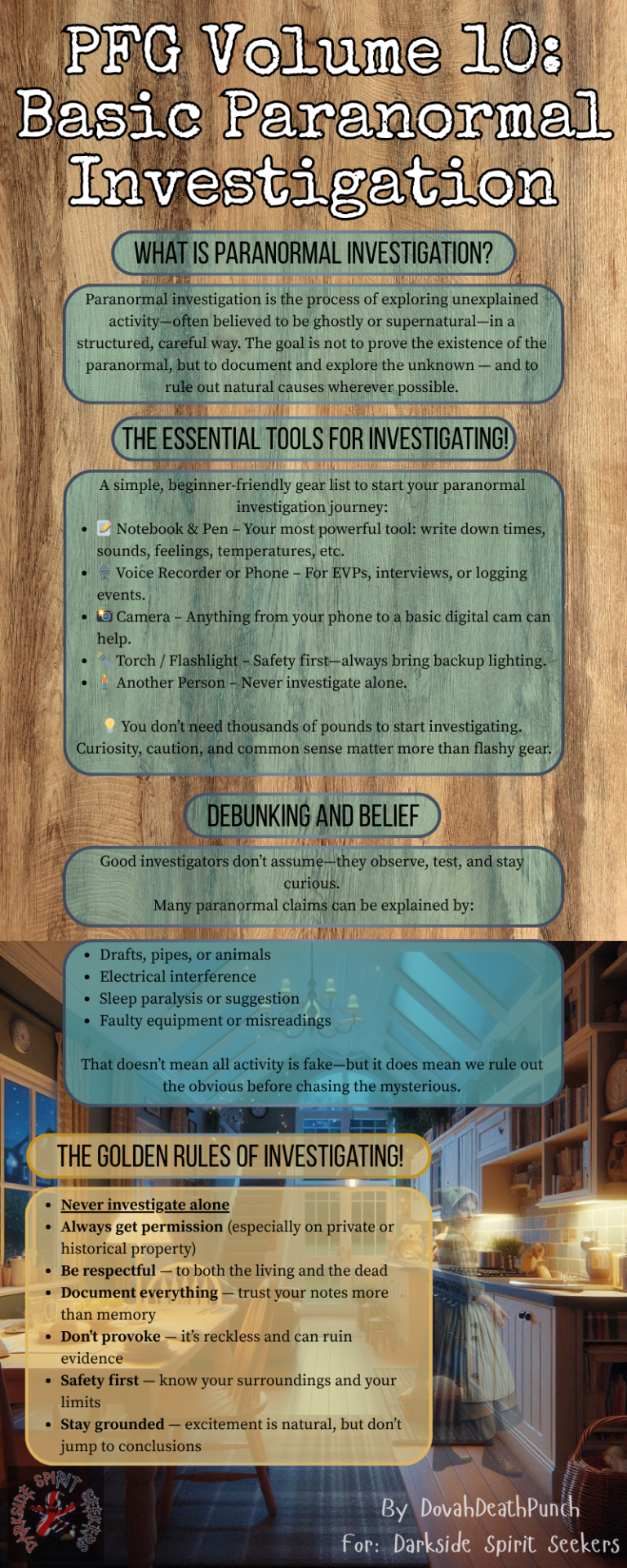
Basic Paranormal Investigating
Basic Paranormal Investigating
Ghost-hunting can be exciting, and it can also be physically exhausting and mentally challenging. Most of the time, the main requirement to be a ghost hunter is having a lot of patience. You also need to know what to do, how to stay safe, and how to gather all the information you can to ensure a professional investigation. Investigating the paranormal can be fun, but it’s also serious business and should be treated with respect and an abundance of caution.
Find Haunted Places
What causes a place to become haunted? No one really knows. In fact, there are so many types of hauntings from human ghosts, to animal ghosts, and even ghost ships, that no one has ever been able to come up with a general theory that can explain all of them. Any single theory would have to cover an immense variety of phenomena, and it just can’t be done. But, of course, the lack of a single, all-encompassing theory is no reason to give up on a search for answers.
According to the definition, a haunting is the repeated manifestation of strange and inexplicable sensory phenomena at a certain location. Hauntings have no general patterns, which is what makes them so hard to define. Some phenomena may manifest on occasion, or even continually, for periods that last from several days to centuries. Other manifestations may occur only on certain anniversaries, in accordance with distinctive weather conditions or for reasons that make no sense whatsoever.
Most hauntings involve apparitions or visual spirits, noises like phantom footsteps, unexplained sounds, tapping, knocking, and even voices and whispers. They can also include strange smells, sensations like the prickling of skin, cold spots and breezes, and being touched by unseen hands. Other hauntings can involve poltergeist activity, such as furniture and objects being moved about, broken glass, doors that open and close by themselves, and the manipulation of lights and electrical devices, circuits, and outlets.
Visitors to haunted places often report a variety of emotions, including anger and fear when negative forces are at work. Other sites seem to involve friendly, or at least benign, emotions.
There are some basic types of hauntings:
- Traditional hauntings: The most widely known type of haunting, involving the spirit —or personality — of a dead person who remains behind at a location after death.
- Residual hauntings: The most common type of haunting, when energy from past events leaves an impression on a place as a type of recording and repeats itself over and over again.
- Poltergeist-like activity A haunting caused by energy generated by a living person, resulting in electrical activity and displacement of objects at a location.
- Portal hauntings: A controversial type of haunting that can involve thin spots. or entrances from this world to the next. Often associated with magnetic areas and violent hauntings.
- Demonic hauntings: Another controversial type of haunting involving something more dangerous, and more frightening, than ghosts. The definition of what a demon is widely varies but can refer to nonhuman, malevolent spirits that prey on families and locations.
- Haunted objects: Possessed possessions, items to which ghosts and negative spirits become attached.
Where the Ghosts Are
The following is a list of some of the places where paranormal researchers have had good luck in finding ghosts and hauntings throughout the years:
- Private residences and historic homes
- Cemeteries
- Theaters
- Ghost towns
- Schools and colleges
- Hotels
- Battlefields and crime scenes
- Hospitals and asylums
- Jails and prisons
A Ghost-Hunter’s Toolkit
There is a lot to know when you begin your paranormal investigations. You should always be learning and having an open mind about exploring new things and new ideas. No two paranormal investigators do things in the exact same way, but everyone should have a checklist of the essential items that are needed for their research. What follows is a checklist for the basic, the essential, and the high-tech items that can be used for investigations.
Basic items
Here is the list of basic items:
- Notebook and pen (recording notes, witness statements, and making diagrams)
- Measuring tape (checking distance and witness accounts)
- Extra batteries (you never know when they might fail)
- Flashlight (this requires no explanation)
- Recording device (for witness accounts and for Electronic Voice Phenomenon [EVP])
- Small tool kit (some electronic devices require screwdrivers)
- Camera (for documenting the location and anomalous photographs)
- Video camera (for documenting the location and investigation, plus interviews)
- Two-way radios (allows the group to stay in contact, plus avoids the electromagnetic interference that is caused by cellular phones)
Essential items
Electronic devices serve a variety of purposes during an investigation. They are used to document your location and can serve as both an alert that a spirit may be present and also for showing what is not a ghost. Many devices in tool kits are pieces of equipment that have been adapted for ghost research. These devices are not foolproof. Most were originally designed to check for electromagnetic surges caused by household wiring and industrial equipment, so adapting them for the paranormal requires a lot of knowledge about exactly how they work and what the readings mean. For this reason, these devices are best used in conjunction with eyewitness accounts, when monitoring locations, and with other investigative techniques. No single piece of evidence can stand on its own, which is why investigators are always looking for corresponding evidence during their research. In this case, anomalous readings on an EMF meter become more intriguing when they are backed up by something else, like a cold spot, witness account, or with other equipment at the same time.
Electronic equipment can be expensive, which is a sobering thought for investigators on a tight budget. However, you can use other low-cost items, such as a compass or dowsing rod, to check for magnetic energy.
High-tech items
If you want to advance your research, then it’s time to invest in an EMF (Electro-Magnetic Field) detector. There are many on the market, from the inexpensive (which are notorious for picking up electrical wiring and faulty appliances) to the most complex. To try and make a list of every electronic device that has been — or will ever be — adapted for use in paranormal investigations would be an endless task, but there are items on the market that you might consider:
- The REM pod: The REM pod can detect a difference in field strength whenever a conductive material enters into its EM field.
- Infrared motion detectors: They can be used to secure an area from intrusion by the living, register the movement of energy fields, and even pick up temperature changes in the monitored area.
- Temperature-sensing devices: It is critical to monitor the ambient temperature of the site. Many sensors on the market can quickly detect temperature changes. When investigators or witnesses talk about cold spots, this is a way to confirm their existence.
- P-SB7 Spirit Box: This device seeks out paranormal voices on the EMF spectrum and because it is believed that spirits contain electromagnetic energy, it makes sense that you can hear them with this device.
- Ovilus: This device was created to convert environmental readings into real words, offering direct responses to your questions.
Guidelines for Your Investigation
These are a few of the guidelines, ideas, hints, tips, and suggestions for investigating the paranormal.
- Make sure you have permission to conduct an investigation.
- Keep your perceptions clear prior to the investigation. Never drink or smoke during or before an investigation.
- Arrive with an open mind. Always be aware that there may be a natural explanation for what is happening.
- Make sure that you bring along all the items that you need to properly conduct your investigation.
- Interview the witness in depth, repeating questions, if necessary. This will allow you to tell how consistent the experience account is and whether any of the witnesses may be embellishing their version of the story.
- Make sure that the witnesses are comfortable with the investigation and understand what you are doing.
- Try some field experiments to reconstruct the events. Let the witness walk you step-by-step through the encounter or experience and have them explain their feelings at the time.
- Always respect the location and whatever ghosts might be present. It is important to be respectful of the living and the dead.
What Not to Do as a Ghost Hunter
Many things that can happen in the course of a paranormal investigation, and not all of them are good. The list that follows offers some ideas and guidelines of things that you should avoid.
- Never investigate alone. Investigations are not only more exciting with a team, they’re also much safer. Having other sets of hands allows you to have help during the investigation, gives you corroboration for anything strange that happens, and keeps you from walking into any problematic or volatile domestic situations at locations where you investigate.
The only time investigating alone may be allowed is if the investigator has many years of experience and if the investigator’s team is also present somewhere at the location. If a bad situation does arise, the investigator can still contact someone for assistance.
- Never eat or chew gum during EVP sessions. This seems like an obvious one, but you may be surprised. Eating or chewing gum while investigating is never a good idea, but it is even worse when trying to record credible EVP sessions.
- Never bring children to an investigation. Team members for your investigation should always be made up of members over the age of 16. This is legally smart in many ways and safer for everyone involved.
- Never review your evidence half-heartedly. If you are going to record hours of tape during an investigation, then you must watch all of it, often frame by frame. The same goes for your hours of EVP. It all must be listened to, and while it can be boring, it is a crucial part of the investigation.
- Never drink alcohol or use drugs during an investigation. This can be dangerous in many ways, not only physically, but mentally and spiritually, as well.
- Never trespass on private property. Always get clear and specific permission from the owners of private property before an investigation.
- Never leave your cell phone on during an investigation. Text messages, phone calls, and sounds from your smart phone can contaminate your investigations and can be very distracting. In addition, Bluetooth connections and incoming calls and messages —even when your phone is switched to silent —can disrupt equipment and audio recordings with interference feedback.
- Never bring disruptive people to an investigation. Never bring along anyone to an investigation who is not willing to take things seriously. Bringing someone who is loud, obnoxious, and disrespectful can ruin an investigation of even of the most actively haunted place.
These are a few of the guidelines, ideas, hints, tips, and suggestions for investigating the paranormal. Make sure you have permission to conduct an investigation. Keep your perceptions clear prior to the investigation. Never drink or smoke during or before an investigation. Arrive with an open mind.
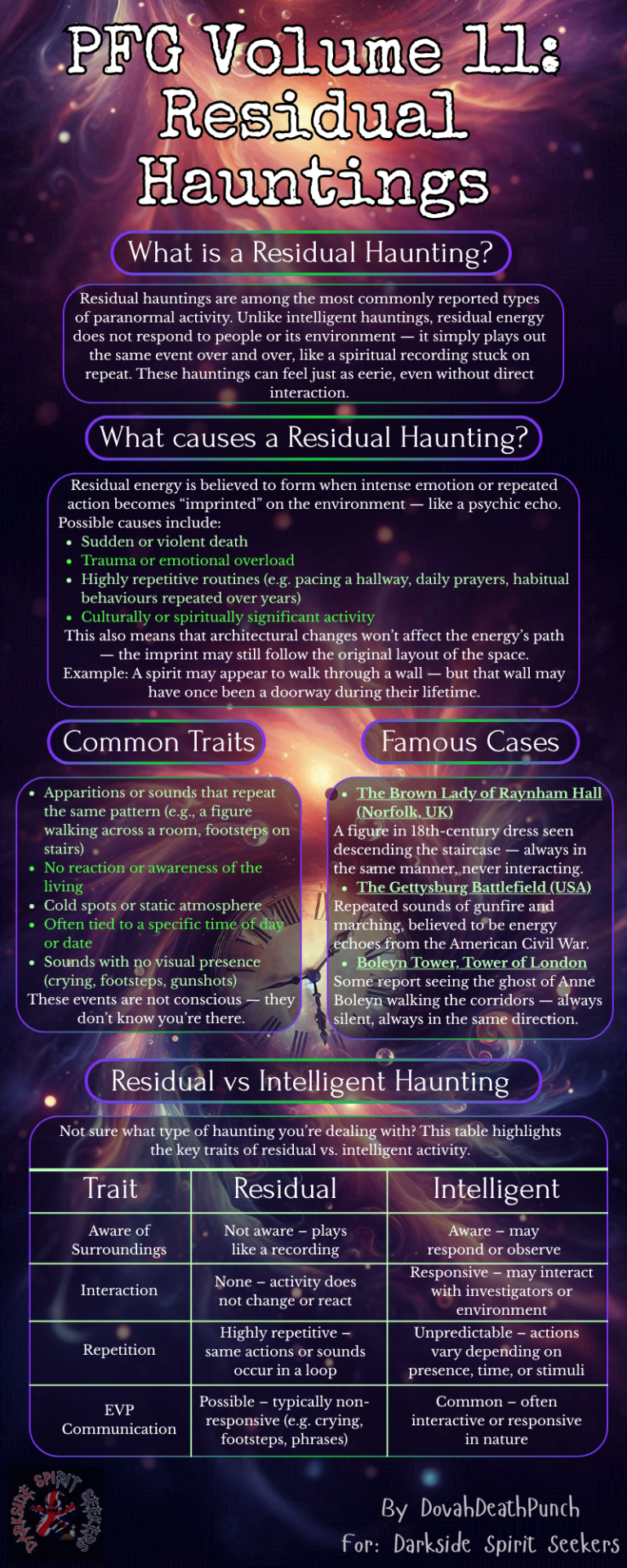
Residual Hauntings
Residual Hauntings
A phenomena where spirits or ghosts keep repeating events. Residual hauntings usually occur in older locations and may be the ghosts reliving important events in their lives—marriages, births, deaths, etc. Some researchers claim that the events are not ghosts in the classic sense, but are energies trapped in the location that repeat like a recording on an “endless loop” of magnetic tape.
Residual Haunting
A residual haunting, also known as a place memory, is the most common type of haunting. In most cases it does not involve a ghost or spirit interacting with the people who are witnessing it. This type of sighting is a remnant of a past traumatic event that happened at or near the location prior to someone’s death. For example, an apparition of a woman may be seen repeatedly looking out of an upstairs bedroom window and pacing the floor. Or noises without a visual scene may be heard, such as footsteps. This same scene or sounds are repeated over and over again in an unchanging loop and often at specific times. Residual hauntings are records of energy that have been imprinted in the area in which the event took place. They are not a direct communication with the living, in fact, they are quite benign and harmless. Some people are more sensitive to observing these hauntings and typically they occur in older buildings, homes and battlefields. It is possible to do some historical research of a location to determine the event that might have caused the haunting.
Intelligent Haunting
An intelligent haunting is also known as a traditional or classic haunting. It is called an intelligent haunting due to the fact that the spirit is aware of and able to interact and communicate with those living in the physical world. These spirits want to get the attention of the living and they can move or hide objects, send signals or even speak to do so. The optimal time for ghostly appearances is during the late night hours, but the spirits who can muster up enough energy can make their presence known in the daytime. There can be many reasons why an intelligent haunting occurs. In many cases, some entities choose to stick around their loved ones, for example, grandparents around younger children. Some are unaware that they have died because it may have happened suddenly. In those instances, the assistance of a psychic medium may be necessary to help them cross over to the other side. Other times, the spirit may not be visible – a cold spot, experiencing chills and goosebumps or feeling as if someone is staring at you are signs. Sometimes the spirit refuses to cross over until a major issue or unfinished business is resolved in family, business or financial matters. Most of these ghosts are not malicious – they just want to be noticed and have their message heard.
Poltergeist Haunting
The word poltergeist means “noisy ghost” and the term comes from the German words “poltern”, which means to make noise and “geist”, which means ghost. Poltergeist hauntings usually take the form of objects moved, hidden or thrown, disturbing noises, interference with electronic devices, physical attacks and even spontaneous combustion. Objects have also been known to disappear and reappear. Ghosts can be the culprits for these disturbances but some incidents are believed to be the result of psychokinesis (PK), the power to move objects with the mind, consciously or unconsciously. If PK is the cause of the haunting, the individual is most likely moving the objects – unknowingly and unconsciously, due to a compounding of some overwhelming stress or emotional angst the person is suffering in life. Poltergeist hauntings have been associated with young adolescent girls; however, they are not limited to that group. The haunting usually affects a person, female or male, who is possibly under great duress. However, it takes its toll on the whole household or group. Poltergeist hauntings can be sometimes playful or sometimes malicious. When the intent is malicious, objects might be placed in such a way that could cause harm. The hauntings usually start out slowly and increase in intensity until it reaches its peak. This is when the occurrences can be the most dangerous. However, sometimes the disturbances stop abruptly and are never repeated again.
Demonic Haunting
In demonic hauntings, the main goal of the demon is to break down a person’s free will so that it can take over and possess the individual. The deceptive evil spirit enters a home or location to do harm and destroy all that is good and sacred. The demon not only can possess people, it can attach itself to objects. At first, these types of hauntings or possessions may seem benign or non-threatening. They can appear similar to poltergeist hauntings as they usually start out with slight disturbances, such as knocking noises, furniture being moved, etc. The demon may appear as a dark shadow in a location or may first show itself as a benevolent spirit. When the demon finally reveals itself, foul odors, extreme temperature changes and even physical attack can occur. Demons also have the ability to transform and shape shift from human to animal. The demon will try to convince the individual that it is no longer present; however, it lays in wait to strike at a time when the individual is weak or vulnerable. The demon becomes stronger when it senses fear and that is the time when a possession can take place. Another sign of possession is that the possessed individual becomes fluent in many languages, speaks in tongues or has gained knowledge in subjects you knew nothing about prior. The individual possessed will become a shell of his former self and become terribly cruel to those he loves. This type of haunting is not easily resolved – it requires an exorcism. Seek guidance and help from highly trained paranormal investigators, clergymen and others familiar with demonic hauntings.

The Wendigo
The Wendigo
wendigo, a mythological cannibalistic monster in the spiritual tradition of North American Algonquian-speaking tribes. It is associated with winter and described as either a fearsome beast that stalks and eats humans or as a spirit that possesses humans, causing them to turn into cannibals. There are many different spellings and pronunciations for wendigo. In Ojibwe, the term is defined as “a winter cannibal monster,” but its name may derive from the proto-Algonquian word wi-nteko-wa, meaning “owl.”
Description and folklore
Some legends say the wendigo is an emaciated figure with ashen flesh. Others describe it as a giant creature up to 15 feet (4.5 metres) tall or as a beast that grows larger the more it eats. It may have sunken or glowing eyes and sharp yellowed fangs and claws. Its lips are chewed or entirely missing because it has eaten them. It may be hairless or have fur, and it may have pointed ears and horns or antlers like a deer. It smells of rotting flesh and is usually first detected by humans by its horrible odour.
Wendigos are believed to have exceptionally sharp eyesight, hearing, and sense of smell as well as superior strength and speed in order to stalk and overpower their victims. They live in colder climates among the woodlands and lakes of Canada and the northern United States. They can move easily through deep snow and across ice. A shaman may be the only person who can subdue and destroy a wendigo, using either a silver, steel, or iron bullet or a dagger. Some legends, however, claim the wendigo’s heart must be cut out and melted or burned in a fire before its spirit is truly vanquished.
The wendigo is sometimes described as a spirit rather than a physical presence. In Cree mythology, for example, the wendigo is believed to be an evil spirit that possesses humans. The spirit enters a person by biting him or her or through a dream. The possessed person becomes cannibalistic or otherwise deranged or violent. Some people are believed to be more susceptible to becoming possessed by a wendigo, including those who are greedy or gluttonous as well as those who are suffering from hunger or starvation. A colloquial phrase for this experience is “going wendigo.”
History and cultural impact
The wendigo legend exists in the oral history of North American tribes predating Europeans’ arrival in North America. Some anthropologists believe the legend developed as a cautionary tale about the importance of community to guard against individual greed, selfishness, and isolation. The wendigo was a personification of cold and hunger in a time when human survival relied on banding together and sharing resources, particularly during the long, harsh winters of the northern wilderness. The legend may also have served as a warning to children not to wander too far into the woods.
The first known written mention of the wendigo appears in a 1636 report by Paul Le Jeune, a French Jesuit missionary living among the Algonquin people in what is now Quebec. Le Jeune described a woman who warns of an atchen that had eaten some tribal members nearby and that “would eat a great many more of them if he were not called elsewhere.”
A few instances of murder and cannibalism in North America were blamed on the wendigo. These included a case in Alberta, Canada (1879), where a Cree hunter and trapper named Swift Runner claimed a wendigo spirit had entered his dreams and told him to eat his family. He was tried for murder, found guilty, and hanged for his crimes later that year. Another case occurred in 1907 among the Sandy Lake First Nation community in northern Ontario. The tribal shaman, Jack Fiddler, and his brother, Joseph Fiddler, were charged with the murder of Joseph’s daughter-in-law, whom they had strangled to prevent her from becoming possessed by a wendigo. After the brothers’ arrest, Jack Fiddler escaped the police and strangled himself, and Joseph Fiddler died from tuberculosis in prison in 1909.
By the early 20th century, the term wendigo psychosis was being used by psychologists and missionaries to describe a culture-bound syndrome among Native and First Nations people whose symptoms included delusions of becoming possessed by an evil spirit, depression, violence, a compulsion for human flesh, and, in some cases, cannibalism. The syndrome was also diagnosed retroactively in historical cases of cannibalism in North America. However, the existence of the syndrome is disputed by some scientists.
For centuries Indigenous artists and activists have drawn on the wendigo legend both literally and metaphorically to address such issues as colonialism, violence, and environmental destruction. American writer Louise Erdrich’s poem “Windigo” (1984) tells of a man trapped inside a windigo who abducts a young girl, who in turn releases his spirit. Her novel The Round House (2012), which centres on an Ojibwe boy in North Dakota seeking justice after his mother is raped, uses the wendigo legend to explore views of retribution and justice among the boy’s tribe versus those of the U.S. government. In the 21st century, activist Winona LaDuke coined the term Wendigo economics to criticize corporations’ “cannibalistic” effect on Earth.
Since the 19th century, the wendigo legend has also captured the imagination of non-Indigenous authors. In The Wilderness Hunter (1893), the future U.S. president Theodore Roosevelt includes a “goblin story” about a bearlike beast that stalks the camp of two hunters, leaving only one to survive and tell the tale. Readers have interpreted Roosevelt’s beast as being either the legendary Bigfoot or a wendigo. British writer Algernon Blackwood’s novella The Wendigo (1910) tells a similar story of a mysterious monster hunting a campsite in the Canadian wilderness, and American novelist Stephen King features a wendigo in the horror story Pet Sematary (1983). Canadian writer Margaret Atwood examines the wendigo legend in Strange Things: The Malevolent North in Canadian Literature (1995), a book of lectures on the imaginative landscape of Canadian literature.
Wendigos have also found their way into the plots of television shows such as Hannibal, video games such as Until Dawn, and comic books, including The Incredible Hulk and Wolverine. A wendigo character also appears in the action film The Lone Ranger (2013), despite the plot’s southwestern U.S. setting. In director Scott Cooper and producer Guillermo del Toro’s Antlers (2021), the wendigo is a deerlike creature in a story that combines supernatural horror and generational trauma in a small-town setting.
Darkside Spirit Seekers PFG Cards
Darkside Spirit Seekers PFG Volume Cards Continued
Continuation of the PFG Cards Explaining Different areas of Paranormal ETC
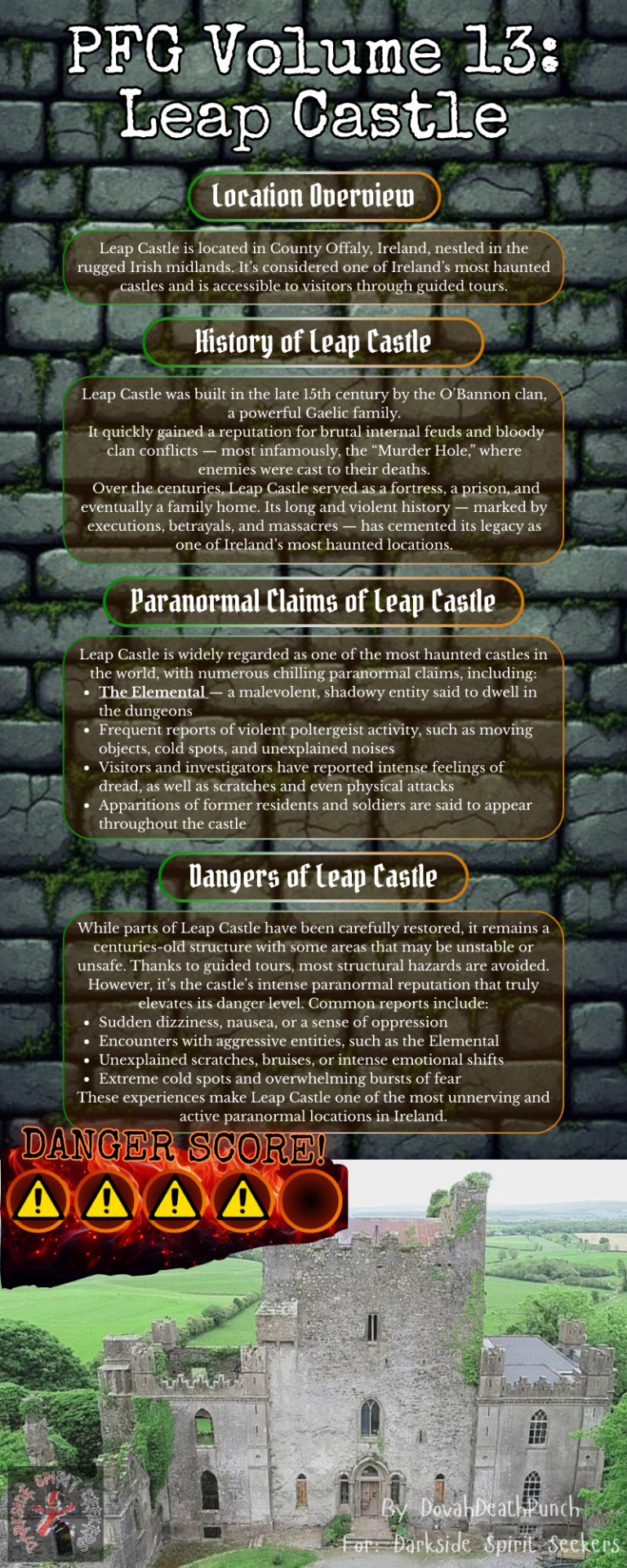
Leap Castle Ireland
Leap Castle Ireland
Leap Castle (/ˈlɛp/; Irish: Caisleán Léim Uí Bhánáin (IPA:[ˈkaʃlʲaːn̪ˠlʲeːmʲiːˈwaːn̪ˠaːnʲ])) is a castle in Roscrea, County Offaly, Ireland, about 6 kilometres (3.7 mi) north of the town of Roscrea and 10 kilometres (6.2 mi) south of Kinnitty on the R421.
History
There are varied accounts as to when exactly the main tower/keep was constructed, ranging anywhere from the 13th century to the late 15th century, but most likely around 1250 AD. It was built by the O'Bannon clan and was originally called "Léim Uí Bhanáin" (as was the fertile land around the castle which was associated with the Bannon clan) or "Leap of the O'Bannons". The O'Bannons were the "secondary chieftains" of the territory and were subject to the ruling O'Carroll clan. There is evidence that it was constructed on the same site as another ancient stone structure, perhaps ceremonial in nature, and that that area has been occupied consistently since at least the Iron Age (500 BCE) and possibly since Neolithic times.
The Annals of the Four Masters record that the Earl of Kildare, Gerald FitzGerald, tried unsuccessfully to seize the castle in 1513. Three years later, he attacked the castle again and managed to partially demolish sections of it. However, by 1557, the O'Carrolls had regained possession.
Following the death of Mulrooney O'Carroll in 1532, family struggles plagued the O'Carroll clan. A fierce rivalry for leadership erupted within the family. The bitter fight for power turned brother against brother. One of the brothers was a priest. While he was holding mass for a group of his family (in what is now called the "Bloody Chapel"), his rival brother burst into the chapel, plunged his sword into him and fatally wounded him. The butchered priest fell across the altar and died in front of his family.
In 1642, the castle passed by marriage into the ownership of the Darby family, notable members of whom included Vice-Admiral George Darby, Admiral Sir Henry D'Esterre Darby and John Nelson Darby. During the tenure of one Jonathan Charles Darby, séances were held in the castle by his wife Mildred Darby, who was a writer of Gothic novels: this led to publicity about the castle and its ghosts. The central keep was later expanded with significant extensions, but in order to pay for these, rents were raised, and much of the land accompanying the castle was sold. This is one theorised motivation for the burning of the castle during the Irish Civil War in 1922. After its destruction, Mr. Darby obtained a reinstatement estimate from Beckett & Medcalf, surveyors in Dublin, that was issued in September 1922. Confusingly, it gives the address as Leap Castle, Roscrea, County Tipperary. The net "Amount of Claim" was £22,684.19.1, equivalent to about €1m in 2018. The claim was settled for a lesser amount.
In 1974 the now ruined castle was bought by Australian historian Peter Bartlett, whose mother had been a Banon. Bartlett, together with builder Joe Sullivan, carried out extensive restoration work on the castle up to the time of his death in 1989. Since 1991, the castle has been privately owned by the musician Sean Ryan and his wife Anne, who continue the restoration work.
In popular culture
The castle has been visited by paranormal investigators from ABC Family's Scariest Places on Earth and Living TV's Most Haunted in its first season, as well as The Atlantic Paranormal Society (TAPS) from Syfy's Ghost Hunters. In August 2014, Travel Channel's Ghost Adventures filmed their tenth season Halloween special at the castle, and most recently by paranormal investigation Youtube channel Sam and Colby. The claims of paranormal activity include the putative existence of a Red Lady ghost, the ghosts of two girls, and an "elemental spirit" associated with Mildred Darby. The castle describes itself as "the world's most haunted castle".
This castle was featured on the cover of several editions of the novel The Riders by Tim Winton.
In 1996, Leap Castle's history and hauntings were examined in Castle Ghosts of Ireland by Robert Hardy.
A chapter in "The World of Lore: Dreadful Places" by Aaron Mahnke is also dedicated to Leap Castle. It is titled The Tainted Well in reference to the castle's gruesome oubliette. The castle is also featured in his podcast Lore, Episode 68: The Tainted Well.
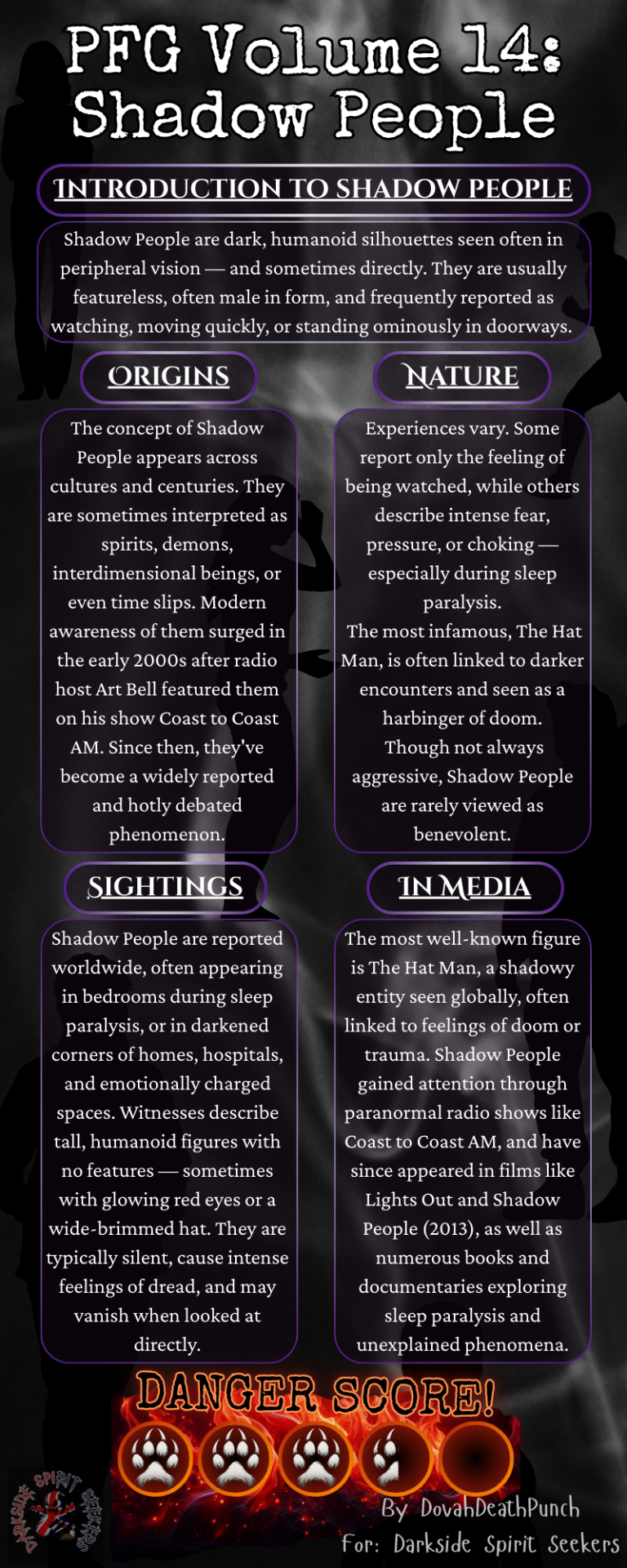
Shadow People Explained
Shadow People Explained
Have you ever been reading or watching TV when suddenly, in the periphery of your vision, you catch glimpse of what appears to be a shadowy figure in the room with you? Dark, humanoid figures like these are commonly known as shadow people, and they can be extremely scary and unsettling to the people who experience seeing them. But defining exactly what shadow people are (and if they’re actually paranormal) is up for debate.
Descriptions of shadowy, human-like figures have appeared in folklore and religious texts throughout history and across cultures. Some examples include the supernatural creatures known as “djinn” of ancient Islamic theology and the beings known as “Nalusa Chito” of the Native American Choctaw tribe’s mythology. The modernly-used term “shadow people” was coined by paranormal researcher and book author Heidi Hollis, who claims that shadow people have been around since the beginning of time and usually appear as dark human-shaped silhouettes in our peripheral vision.
The fear of the dark (and all of its shadows) is a common one, probably because our eyes tend to play tricks on us when the lights are low. A jacket hanging on the door can easily morph into a silhouette, and a pile of blankets could suddenly look like someone lurking in your bed. But could shadow people be more than that? Here’s what you need to know about shadow people and what it means if you see one.
What Are Shadow People?
“Shadow people are a bit of an enigma in the paranormal community,” professional witch and psychic Renée Watt tells Bustle. “They are often thought of as ghosts or a collection of negative energy — but as is true with most paranormal phenomena, there is no finite answer.” According to Watt, shadow people can appear in different forms and may even indicate that someone is under a psychic attack. Many paranormal experts also theorize that there may be a connection between shadow people and extra-terrestrial life — and that these beings could be other-worldly in origin or have a correlation with alleged alien abduction experiences.
While the exact supernatural origin of these shadow-like beings is debated among paranormal experts, there is one thing that most agree upon — which is that the presence of shadow people is wholly unsettling. “These shadowy, human-like entities have a bit of a murky reputation, as most people who report seeing them state that they feel uncomfortable, scared, and in some extreme cases, even paralyzed with fear,” Watt says. Most reports on shadow people are overwhelmingly negative and are accompanied by a feeling of dread.
Do Shadow People Have A Scientific Explanation?
Skeptics note that seeing shadow people could simply be chalked up to sleep paralysis — which is a medical phenomenon that takes place when someone is in between a sleeping and wakeful state. During sleep paralysis, a person feels fully conscious but they’re unable to move or speak and may experience a feeling of intense dread, the sensation of being suffocated, or even hallucinations of shadowy figures. Other potential explanations include experiencing heightened emotional states, sleep deprivation, or substance use.
It’s also important to consider that most shadow person sightings appear in our peripheral vision, which is designed to detect motion and movement, not detail. That said, it would be easier to mistake something in the corner of our eye for something it isn’t than it would be if we were to see something head-on.
What To Do If You See A Shadow Person
It’s normal to feel fearful if you see something as inexplicable as a shadow person — but according to experts, it’s best to focus on staying grounded and not letting yourself be overwhelmed by the discomfort of what you’re experiencing. “If you encounter a shadow person, the worst thing you can do is give it your fear, as entities with negative intent thrive on their ability to make us feel unsafe or uncomfortable,” Watt says. “The best thing you can do is call in spiritual protection, pray, or simply stand your ground by firmly telling the shadow person to leave you alone.”
A one-off encounter with a shadow being can be creepy, but if your visions of these entities are ongoing, it might indicate that it’s time to do some spiritual cleansing of your energy field and your living space. “If you're having multiple experiences with shadow people, you may want to consider doing a major energetic house cleansing or hiring a professional energy worker to do one for you,” Watt says. You can spiritually cleanse your home (and hopefully keep shadow people at bay) by performing a protection ritual, putting out cleansing crystals in your home, or burning purifying herbs.
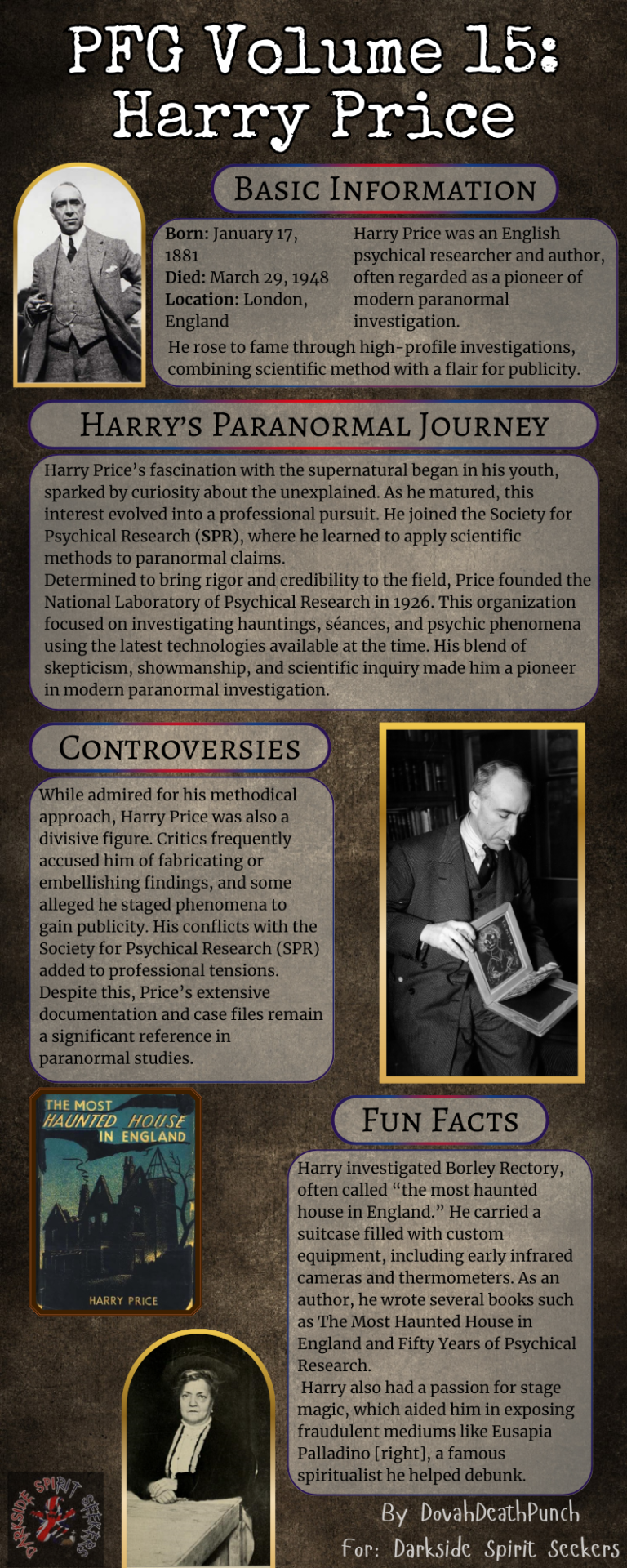
Harry Price
Harry Price
Harry Price (17 January 1881 – 29 March 1948) was a British psychic researcher and author, who gained public prominence for his investigations into psychical phenomena and exposing fraudulent spiritualist mediums. He is best known for his well-publicised investigation of the purportedly haunted Borley Rectory in Essex, England.
Early life
Although Price claimed his birth was in Shropshire he was actually born in London in Red Lion Square on the site of the South Place Ethical Society's Conway Hall. He was only son and second child of Edward Ditcher Price (1834-1906), then traveller (salesman) for the paper manufacturing firm of Edward Saunders and Son, and his wife Emma Randall nee Meech (1860-1902). His father being born at Rodington in Shropshire, Price spent much time in the county in holidays with relatives. He was educated in New Cross, first at Waller Road Infants School and then Haberdashers' Aske's Hatcham Boys' School. He completed his education at Goldsmiths College, studying chemistry, photography, electrical and mechanical engineering. In Who's Who, he claimed to have been educated in Shropshire as well as London but did not name his schools.
At 15, Price founded the Carlton Dramatic Society and wrote plays, including a drama, about his early experience with a poltergeist which he said took place at a haunted unnamed manor house in Shropshire.
According to Richard Morris, in his biography Harry Price: The Psychic Detective (2006), Price came to the attention of the press when he claimed an early interest in space-telegraphy. He set up a receiver and transmitter between Telegraph Hill, Lewisham and St Peter's Church Brockley and captured a spark on a photographic plate. This, though, was nothing more than Price writing a press release saying he had performed the experiment, as nothing was verified.
The young Price also had an avid interest in coin collecting and wrote several articles for The Askean, the magazine for Haberdashers' School. In his autobiography, Search for Truth, written between 1941 and 1942, Price claimed he was involved with archaeological excavations in Greenwich Park, London, but, in earlier writings on Greenwich, he denied any such involvement. He also claimed to have uncovered Roman coins while earlier excavating at the site of Uriconium in Wroxeter, Shropshire. From 1902 to 1904 he serialised an article on "Shropshire Tokens and Mints" in the Wellington Journal and Shrewsbury News, at age 21 published his first book, on The Coins of Kent, and served as honorary curator of numismatics at Ripon Museum, North Yorkshire, in 1904.
From around May 1908 Price continued his interest in archaeology at Pulborough, Sussex, where he had moved prior to marrying Constance Mary Knight, only daughter of Robert Hastings Knight, on 1 August that year. As well as working as a salesman for paper merchants Edward Saunders & Sons, he wrote for two local Sussex newspapers: the West Sussex Gazette and the Southern Weekly News in which he related his remarkable propensity for discovering 'clean' antiquities. One of these, a 'silver' ingot (discovered by Richard Morris to be housed in Price's collection of artefacts at Senate House, University of London and made of base materials) was stamped around the time of the last Roman emperor Honorius. A few years later, another celebrated Sussex archaeologist, Charles Dawson, found a brick at Pevensey Fort in Sussex, which was purportedly made in Honorius' time. In 1910 Professor Francis J. Haverfield of Oxford University, the country's foremost expert on Roman history and a Fellow of the Royal Academy, declared the ingot to be a fake. A report for the Proceedings of the Society of Antiquaries (number 23, pages 121–9) in the same year reported that:
'... the double axe type of silver ingot was well known and dated from late Imperial times but the one recovered from Sussex was an inferior copy of one found at the Tower of London, with alterations to give it an air of authenticity. Both the shape and lettering betrayed its origin.'
Through his father, who died in 1906, he inherited a share in the paper firm which gave him more independent means to support his interests. At the start of the First World War he attempted to enlist for service but was medically rejected because of heart strain though he offered the Royal Flying Corps assistance with colour filters for aerial photography. At his Pulborough home he set up a workshop for making shell-fuses and in 1918 worked as night shift foreman at a munitions works in Tottenham.
Interest in magic and conjuring
In his autobiography, Search for Truth, Price said encountering the "Great Sequah" in Shrewsbury was "entirely responsible for shaping much of my life's work", and led to him acquiring the first volume of what would become the Harry Price Library. He met the purportedly Native American magician when the latter appeared with a troupe in 1889 when Price was aged eight and reportedly cured Price of a toothache. Price later became an expert amateur conjurer, joined the Magic Circle in 1922 and maintained a lifelong interest in stage magic and conjuring. His expertise in sleight-of-hand and magic tricks stood him in good stead for what would become his all consuming passion, the investigation of paranormal phenomena.
The psychical researcher Eric Dingwall and Price re-published an anonymous work written by a former medium entitled Revelations of a Spirit Medium (1922) which exposed the tricks of mediumship and the fraudulent methods of producing "spirit hands". Originally all the copies of the book were bought up by spiritualists and deliberately destroyed.
Psychical research
A photograph by William Hope showing Price with a "spirit"
Price joined the Society for Psychical Research (SPR) in 1920. He used his knowledge of conjuring to debunk fraudulent mediums, but unlike other magicians, Price endorsed some mediums that he believed were genuine. Price's first major success in psychical research came in 1922 when he exposed the 'spirit' photographer William Hope. In the same year he travelled to Germany together with Eric Dingwall and investigated Willi Schneider at the home of Baron Albert von Schrenck-Notzing in Munich. In 1923, Price exposed the medium Jan Guzyk; according to Price, the "man was clever, especially with his feet, which were almost as useful to him as his hands in producing phenomena".
Price wrote that the photographs depicting the ectoplasm of the medium Eva Carrière taken with Schrenck-Notzing looked artificial and two-dimensional, as if made from cardboard and newspaper portraits, and that there were no scientific controls as both her hands were free. In 1920, Carrière was investigated by psychical researchers in London. An analysis of her ectoplasm revealed it to be made of chewed paper. She was also investigated in 1922 and the result of the tests were negative. In 1925, Price investigated Maria Silbert and caught her using her feet and toes to move objects in the séance room. He also investigated the "direct voice" mediumship of George Valiantine in London. In the séance Valiantine claimed to have contacted the "spirit" of the composer Luigi Arditi, speaking in Italian. Price wrote down every word that was attributed to Arditi and they were found to be word-for-word matches in an Italian phrase-book.
Price formed an organisation in 1925 called the National Laboratory of Psychical Research as a rival to the Society for Psychical Research. Price had a number of disputes with the SPR, most notably over the mediumship of Rudi Schneider. Price paid mediums to test them-the SPR criticised Price and disagreed about paying mediums for testing.
Price made a formal offer to the University of London to equip and endow a Department of Psychical Research, and to loan the equipment of the National Laboratory and its library. The University of London Board of Studies in Psychology responded positively to this proposal. In 1934, the National Laboratory of Psychical Research, which held Price's collection, was reconstituted as the University of London Council for Psychical Investigation with C. E. M. Joad as chairman and with Price as Honorary Secretary and editor, although it was not an official body of the university. In the meantime, in 1927 Price joined the Ghost Club, of which he remained a member until it (temporarily) closed in 1936.
In 1927, Price claimed that he had come into possession of Joanna Southcott's box, and arranged to have it opened in the presence of one reluctant prelate (the Bishop of Grantham, not a diocesan bishop but a suffragan of the Diocese of Lincoln): it was found to contain only a few oddments and unimportant papers, among them a lottery ticket and a horse-pistol. His claims to have had the true box have been disputed by historians and by followers of Southcott. Price exposed Frederick Tansley Munnings, who claimed to produce the independent "spirit" voices of Julius Caesar, Dan Leno, Hawley Harvey Crippen and King Henry VIII. Price invented and used a piece of apparatus known as a voice control recorder and proved that all the voices were those of Munnings. In 1928, Munnings admitted fraud and sold his confessions to a Sunday newspaper.
Price was friends with other debunkers of fraudulent mediums including Harry Houdini and the journalist Ernest Palmer.
Harry Price pictured with assorted pieces of his "ghost hunting" equipment
In 1933, Frank Decker was investigated by Price at the National Laboratory of Psychical Research. Under strict scientific controls that Price contrived, Decker failed to produce any phenomena at all. Price's psychical research continued with investigations into Karachi's Indian rope trick and the fire-walking abilities of Kuda Bux in 1935. He was also involved in the formation of the National Film Library (British Film Institute) becoming its first chairman (until 1941) and was a founding member of the Shakespeare Film Society. In 1936, Price broadcast from a supposedly haunted manor house in Meopham, Kent for the BBC and published The Confessions of a Ghost-Hunter and The Haunting of Cashen's Gap. This year also saw the transfer of Price's library on permanent loan to the University of London (see external links below), followed shortly by the laboratory and investigative equipment. In 1937, he conducted further televised experiments into fire-walking with Ahmed Hussain at Carshalton and Alexandra Palace, and also rented Borley Rectory for one year. The following year, Price re-established the Ghost Club, with himself as chairman, modernising it and changing it from a spiritualist association to a group of more or less open-minded sceptics that gathered to discuss paranormal topics. He was also the first to admit women to the club.
In the same year, Price conducted experiments with Rahman Bey who was "buried alive" in Carshalton. He also drafted a Bill for the regulation of psychic practitioners. In 1939, he organised a national telepathic test in the periodical John O'London's Weekly. During the 1940s, Price concentrated on writing and the works The Most Haunted House in England, Poltergeist Over England and The End of Borley Rectory were all published.
Price was offered by the government of Nazi Germany the Red Cross Medal if he would start a department of parapsychology at the University of Bonn but the project was frustrated by the outbreak of the Second World War and he did not receive the medal or a university doctorate that had also been offered over the same project.
Famous cases
William Hope
Main article: William Hope (paranormal investigator)
On 4 February 1922, Price with James Seymour, Eric Dingwall and William Marriott had proven the spirit photographer William Hope was a fraud during tests at the British College of Psychic Science. Price wrote in his SPR report "William Hope has been found guilty of deliberately substituting his own plates for those of a sitter … It implies that the medium brings to the sitting a duplicate slide and faked plates for fraudulent purposes."
Price secretly marked Hope's photographic plates, and provided him with a packet of additional plates that had been covertly etched with the brand image of the Imperial Dry Plate Co. Ltd. in the knowledge that the logo would be transferred to any images created with them. Unaware that Price had tampered with his supplies, Hope then attempted to produce a number of Spirit photographs. Although Hope produced several images of alleged spirits, none of his materials contained the Imperial Dry Plate Co. Ltd logo, or the marks that Price had put on Hope's original equipment, showing that he had exchanged prepared materials containing fake spirit images for the provided materials.
Price later re-published the Society's experiment in a pamphlet of his own called Cold Light on Spiritualistic "Phenomena" – An Experiment with the Crewe Circle. Due to the exposure of Hope and other fraudulent spiritualists, Arthur Conan Doyle led a mass resignation of eighty-four members of the Society for Psychical Research, as they believed the Society was opposed to spiritualism. Doyle threatened to have Price evicted from his laboratory and claimed if he persisted to write "sewage" about spiritualists, he would meet the same fate as Houdini. Doyle and other spiritualists attacked Price and tried for years to have Price take his pamphlet out of circulation. Price wrote "Arthur Conan Doyle and his friends abused me for years for exposing Hope.
Eileen Garrett
Main article: Eileen J. Garrett
On 7 October 1930 it was claimed by spiritualists that Eileen J. Garrett made contact with the spirit of Herbert Carmichael Irwin at a séance held with Price at the National Laboratory of Psychical Research two days after the R101 disaster, while attempting to contact the then recently deceased Arthur Conan Doyle, and discussed possible causes of the accident. The event "attracted worldwide attention", thanks to the presence of a reporter. Major Oliver Villiers, a friend of Brancker, Scott, Irwin, Colmore and others aboard the airship, participated in further séances with Garrett, at which he claimed to have contacted both Irwin and other victims. Price did not come to any definite conclusion about Garrett and the séances:
It is not my intention to discuss if the medium were really controlled by the discarnate entity of Irwin, or whether the utterances emanated from her subconscious mind or those of the sitters. "Spirit" or "trance personality" would be equally interesting explanations – and equally remarkable. There is no real evidence for either hypothesis. But it is not my intention to discuss hypotheses, but rather to put on record the detailed account of a remarkably interesting and thought-provoking experiment.
Garrett's claims have since been questioned. The magician John Booth analysed the mediumship of Garrett and the paranormal claims of R101 and considered her to be a fraud. According to Booth Garrett's notes and writings show she followed the building of the R101 and she may have been given aircraft blueprints by a technician from the airdrome. However, the researcher Melvin Harris who studied the case wrote no secret accomplice was needed as the information described in Garrett's séances were "either commonplace, easily absorbed bits and pieces, or plain gobbledegook. The so-called secret information just doesn't exist."
Rudi Schneider
Main article: Rudi Schneider
In the 1920s and early 1930s Price investigated the medium Rudi Schneider in a number of experiments conducted at the National Laboratory of Psychical Research. Schneider claimed he could levitate objects but according to Price a photograph taken on 28 April 1932 showed that Schneider had managed to free his arm to move a handkerchief from the table. After this, many scientists considered Schneider to be exposed as a fraud. Price wrote that the findings of the other experiments should be revised due to the evidence showing how Schneider could free himself from the controls.
After Price had exposed Schneider, various scientists, such as Karl Przibram and the magician Henry Evans, wrote to Price telling him that they agreed that Schneider would evade control during his séances and congratulated Price on the success of unmasking the fraud. In opposition, SPR members who were highly critical of Price, supported Schneider's mediumship and promoted a conspiracy theory that Price had hoaxed the photograph. SPR member Anita Gregory claimed Price had deliberately faked the photograph to discredit SPR research and ruin Schneider's reputation. However, a photographic expert testified that the photograph was genuine. SPR member John L. Randall reviewed the Price and Schneider case and came to the conclusion that the photograph was genuine and that Price had caught Schneider in fraud.
Helen Duncan
Main article: Helen Duncan
Helen Duncan with a roll of cheesecloth.
In 1931, the National Laboratory of Psychical Research took on its most illustrious case. £50 was paid to the medium Helen Duncan so that she could be examined under scientific conditions. Price was sceptical of Duncan and had her perform a number of test séances. She was suspected of swallowing cheesecloth which was then regurgitated as "ectoplasm". Price had proven through analysis of a sample of ectoplasm produced by Duncan, that it was made of cheesecloth. Duncan reacted violently at attempts to X-ray her, running from the laboratory and making a scene in the street, where her husband had to restrain her, destroying the controlled nature of the test. Price wrote that Duncan had given her fake ectoplasm to her husband to hide. The ectoplasm of Duncan in another test was analysed by psychical researchers and reported to be made from egg white. According to Price:
The sight of half-a-dozen men, each with a pair of scissors waiting for the word, was amusing. It came and we all jumped. One of the doctors got hold of the stuff and secured a piece. The medium screamed and the rest of the "teleplasm" went down her throat. This time it wasn't cheese-cloth. It proved to be paper, soaked in white of egg, and folded into a flattened tube ... Could anything be more infantile than a group of grown-up men wasting time, money, and energy on the antics of a fat female crook.
Price wrote up the case in Leaves from a Psychist's Case Book (1933) in a chapter called "The Cheese-Cloth Worshippers". In his report Price published photographs of Duncan in his laboratory that revealed fake ectoplasm made from cheesecloth, rubber gloves and cut-out heads from magazine covers which she pretended to her audience were spirits. Following the report written by Price, Duncan's former maid Mary McGinlay confessed in detail to having aided Duncan in her mediumship tricks, and Duncan's husband admitted the ectoplasm materialisations to be the result of regurgitation. Later Duncan was caught cheating again pretending to be a spirit in the séance room. During Duncan's famous trial in 1944, Price gave his results as evidence for the prosecution. This time Duncan and her travelling companions, Frances Brown, Ernest and Elizabeth Homer were prosecuted and convicted. Duncan was jailed for nine months, Brown for four months and the Homers were bound over.
Brocken experiment
The Brocken experiment
In 1932, Price travelled to Mount Brocken in Germany with C. E. M. Joad and members of the National Laboratory to conduct a 'black magic' experiment in connection with the centenary of Goethe. The "Bloksberg Tryst", involving the transformation of a goat into a young man by the invocation of a maiden, Uta Bohn (better known as the film actress Gloria Gordon, 1881–1962), produced a great deal of publicity but not the magical transformation. Price claimed he carried out the experiment "if only to prove the fallacy of transcendental magic."
Gef
Main article: Gef
In July 1935 Price and his friend Richard Lambert went to the Isle of Man to investigate the alleged case of Gef the talking mongoose and produced the book The Haunting of Cashen's Gap (1936). In the book they avoided saying that they believed the story but were careful to report it as though with an open mind. The book reports how a hair from the alleged mongoose was sent to Julian Huxley who then sent it to naturalist F. Martin Duncan who identified it as a dog hair. Price suspected the hair belonged to the Irving's sheepdog, Mona.
Price asked Reginald Pocock of the Natural History Museum to evaluate pawprints allegedly made by Gef in plasticine together with an impression of his supposed tooth marks. Pocock could not match them to any known animal, though he conceded that one of them might have been "conceivably made by a dog". He did state that none of the markings had been made by a mongoose.
Price visited the Irvings and observed double walls of wooden panelling covering the interior rooms of the old stone farmhouse which featured considerable interior air space between stone and wood walls that "makes the whole house one great speaking-tube, with walls like soundingboards. By speaking into one of the many apertures in the panels, it should be possible to convey the voice to various parts of the house." According to Richard Wiseman "Price and Lambert were less than enthusiastic about the case, concluding that only the most credulous of individuals would be impressed with the evidence for Gef.
The diaries of James Irving, along with reports about the case, are in Harry Price's archives in the Senate House Library, University of London.
Borley Rectory
Main article: Borley Rectory
Borley Rectory in 1892
Price was most famous for his investigation into the Borley Rectory, Essex. The building became known as "the most haunted house in England" after Price published a book about it in 1940. He documented a series of alleged hauntings from the time the rectory was built in 1863. He lived in the rectory from May 1937 to May 1938 and wrote of his experiences in the book.
The psychical researcher John L. Randall wrote there was direct evidence of "dirty tricks" played upon Price by members of the SPR. On 9 October 1931, a past president of the SPR, William Henry Salter, visited the Borley Rectory in an attempt to persuade the Rector Lionel Foyster to sever his links with Price and work with the SPR instead. After Price's death in 1948, Eric Dingwall, Kathleen M. Goldney, and Trevor H. Hall, three members of the Society for Psychical Research, two of whom had been Price's most loyal associates, investigated his claims about Borley. Their findings were published in a 1956 book, The Haunting of Borley Rectory, which concluded Price had fraudulently produced some of the phenomena.
The "Borley Report", as the SPR study has become known, stated that many of the phenomena were either faked or due to natural causes such as rats and the strange acoustics attributed to the odd shape of the house. In their conclusion, Dingwall, Goldney, and Hall wrote "when analysed, the evidence for haunting and poltergeist activity for each and every period appears to diminish in force and finally to vanish away." Terence Hines wrote "Mrs. Marianne Foyster, wife of the Rev. Lionel Foyster who lived at the rectory from 1930 to 1935, was actively engaged in fraudulently creating [haunted] phenomena. Price himself ‘salted the mine’ and faked several phenomena while he was at the rectory.
Robert Hastings was one of the few SPR researchers to defend Price. Price's literary executor Paul Tabori and Peter Underwood have also defended Price against accusations of fraud. A similar approach was made by Ivan Banks in 1996. Michael Coleman in an SPR report in 1997 wrote Price's defenders are unable to rebut the criticisms convincingly.
Price's investigation of Borley was the subject of a 2013 novel by Neil Spring, titled The Ghost Hunters. The novel was subsequently adapted for television as Harry Price: Ghost Hunter, starring Rafe Spall, Cara Theobold and Richie Campbell.
Rosalie
Price claimed to have attended a private séance on 15 December 1937 in which a small six-year-old girl called Rosalie appeared. Price wrote he controlled the room by placing starch powder over the floor, locking the door and taping the windows before the séance. However, the identity of the sitters, or the locality where the séance was held was not revealed due to the alleged request of the mother of the child. During the séance Price claimed a small girl emerged, she spoke and he took her pulse. Price was suspicious that the supposed spirit of the child was no different to a human being but after the séance had finished the starch powder was undisturbed and none of the seals had been removed on the window. Price was convinced no one had entered the room via door or window during the séance. Price's Fifty Years of Psychical Research (1939) describes his experiences at the sitting and includes a diagram of the séance room.
Eric Dingwall and Trevor Hall wrote the Rosalie séance was fictitious and Price had lied about the whole affair but had based some of the details on the description of the house from a sitting he attended at a much earlier time in Brockley, South London where he used to live. K. M. Goldney who had criticised Price over his investigation into Borley Rectory wrote after the morning of the Rosalie sitting she found Price "shaken to the core by his experience." Goldney believed Price had told the truth about the séance and informed the Two Worlds spiritualist weekly newspaper that she believed the Rosalie sitting to be genuine.
In 1985, Peter Underwood published a photograph of part of an anonymous letter that was sent to the SPR member David Cohen in the 1960s which claimed to be from a séance sitter who attended the séance. The letter confessed to having impersonated the Rosalie child in the sitting by the request of the father who had owed the mother of the child money. In 2017, Paul Adams published details of the location of the Rosalie seance and identities of the family involved.
Reception
Psychologist and sceptic Richard Wiseman has praised Price for his work in debunking fraudulent mediums and investigating paranormal claims. According to Wiseman "Price devoted the scientific study to weird stuff ... that both delighted the world's media and infuriated believers and sceptics alike. The stage magician and scientific sceptic James Randi wrote Price accomplished some valuable and genuine research but lived "a strange mixture of fact and fraud.
Psychical researcher Renée Haynes described Price as "one of the most fascinating and storm-provoking figures in psychical research." Science writer Mary Roach in her book Spook: Science Tackles the Afterlife (2010) favourably mentioned Price's methods and research in debunking the fraudulent medium Helen Duncan.
Several biographies have been written about Price. Paul Tabori's biography (1950) is generally sympathetic. Historian Trevor H. Hall's (1978) is much more critical. The latest biography by Richard Morris (2006) is also critical, concluding that Price should best be remembered as a "supreme bluffer, a hedonistic con man, a terrific raconteur, a great conjuror, a gifted writer and a wonderful eccentric."
Death and legacy
Price experienced a massive heart attack at his home in Pulborough, West Sussex and died almost instantly on 29 March 1948. He was buried in the churchyard of St Mary's, Pulborough.
His archives were deposited with the University of London between 1976 and 1978 by his widow. They include his correspondence, drafts of his publications, papers relating to libel cases, reports on his investigations, press cuttings and photographs. His collection of magic books and periodicals is held at Senate House Library, part of the University of London and is called the Harry Price Library of Magical Literature. The collection, which includes 13,000 items, was established by a bequest from his estate in 1948.

PFG Files
More PFG Files Soon
More Great PFG Files Coming Soon Watch This Space